Monday, May 16, 2011

Kate & Anna McGarrigle -- Tell My Sister

KATE & ANNA McGARRIGLE
Tell My Sister
Nonesuch

Tell My Sister, assembled by producer Joe Boyd, and released to coincide with the Kate McGarrigle tribute concerts last week at Town Hall in New York City, is an essential 3-CD set that reissues the first two Kate & Anna McGarrigle albums – Kate & Anna McGarrigle and Dancer with Bruised Knees – along with 21 previously unreleased demos – many of them Kate solo – recorded between 1971 and 1974.

Aside from the fact that they are great albums, those first two Kate & Anna LPs were important to me personally as they (along with the third LP, Pronto Monto) came out during the time that I worked closely with Kate and Anna, producing concerts for them in Montreal and arranging touring concert dates for them at such venues as Convocation Hall in Toronto, the National Arts Centre in Ottawa, Carnegie Hall in New York City, and other places in Canada and the U.S. I wrote more about my friendship and working relationship with Kate and Anna in this article after Kate passed away last year.

The first LP, Kate & Anna McGarrigle, released in 1976, was one of the greatest folk and singer-songwriter LPs of the decade. Every one of the dozen songs – including five written by Kate and four by Anna – is a perfectly polished gem. The singing – in particular the stunning sibling harmonies – is stunning, the arrangements featuring a combination of folk music friends and some of the top studio musicians of the day are as near as you can get to being perfect.

I’ve always thought of Side 1 of the original LP – the first six songs on the CD reissue – as perhaps the most perfect of LP sides, rivalled only by Side 2 of Abbey Road by the Beatles.

The Side 1 suite begins with “Kiss and Say Goodbye,” Kate’s rock ‘n’ roll celebration of a hoped-for night, and segues into “My Town,” Anna’s sad, but gorgeous, lament for a broken heart that features some very pretty mandolin work by David Grisman (who would soon go on to revolutionize how we think about the possibilities of bluegrass instruments). Then, Kate’s “Blues in D,” patterned after the great piano-guitar duo recordings of Leroy Carr & Scrapper Blackwell, and featuring some nifty work by Amos Garrett on acoustic guitar and Joel Tepp on clarinet, leads into Kate and Anna trading verses and adding celestial harmonies to a majestic version of “Heart Like a Wheel.” The days of the Mountain City Four, the legendary Montreal folk group of the 1960s that included Kate and Anna, are recalled with the Wade Hemsworth classic, “Foolish You,” before the side ends with a beautifully orchestrated version of “(Talk to Me of) Mendocino,” Kate’s exquisite ode to New York State, the California coast and lost love.

While Side 1 of the LP – tracks 6-12 on the CD – may have been a perfect album side, there is no fault to be found with the second side. Anna’s “Complainte pour Ste-Catherine,” co-written with Philippe Tatarcheff, and featuring some Cajun-style fiddling by Jay Ungar and Floyd Gilbeau, is one of the McGarrigles’ most enduring French-language songs. “Complainte” leads into “Tell My Sister,” Kate’s song about needing to come home alone from a bad period in her marriage to Loudon Wainwright III. Interestingly, Kate and Anna follow “Tell My Sister” with a fun version of Loudon’s “Swimming Song.” It’s followed by Anna’s “Jigsaw Puzzle of Life,” which describes the first decade of her relationship with her then-boyfriend, soon-to-be-husband Dane Lanken. Then we hear Kate’s stunning, heartbreaking performance of “Go Leave,” a song for dying relationship that she still carried some hope for, before the album ends with a joyous rendition of the Bahaman spiritual “Travelling on for Jesus.”

I’ve listened to Kate & Anna McGarrigle many hundreds of times over the past 35 years. Listening to this newly remastered version, it still sounds as fresh as it did when I first sat down with Kate in 1975 and she played the first rough mixes for me.

Dancer with Bruised Knees, released on LP in 1977, may not have been quite as good as the first album, but it wasn’t off by much. As Joe Boyd says in the Tell My Sister liner notes, “Its only problem was the album it had to follow.”

Among my favourites of Kate’s songs from Dancer are the pastoral “Southern Boys,” the lovely “Walking Song” and “Hommage à Grungie,” a tribute to an artist friend. Favourites of Anna’s include the title track, told from the point of view of an ex-dancer friend (and including a brief parody of Kate’s “Work Song”), the pretty “Naufragée du Tendre,” again co-written, like most of Kate and Anna’s French songs, with Philippe Tatartcheff, and “Kitty Come Home,” Anna’s plea to Kate to leave the scene of her broken marriage and return to Montreal. Another of my favourites is their version of Galt MacDermot and Bill Dumaresq’s “No Biscuit Blues,” a song that predates Montrealer MacDermott’s great success as the composer of the Broadway hit, Hair.

Like the first album, Dancer with Bruised Knees is an album I’ve listened to hundreds of times and it still sounds great after all these years. It’s also an album that has a few personal memories as I visited in the studio a couple of times during the recording process and listened in as Kate and Anna worked on several of the songs.

It’s the third CD in the set – demo recordings from 1971-1974 – that  makes Tell My Sister essential for Kate & Anna fans that still have copies of the original LPs or CD reissues. These 21 tracks, lasting more than an hour, and including two versions each of “Heart Like a Wheel” and “(Talk to Me of) Mendocino,” are absolutely wonderful. While most of the songs would end up being recorded on later Kate & Anna albums, there are six songs, including “Annie,” a never-released gem written by Chaim Tannenbaum and sung by Kate, that have never before appeared on any of Kate and Anna’s albums.

The solo songs reveal that Kate, had she pursued a solo career, would have been at the top of the folk and singer-songwriter scene. Most of her naked solo performances are every bit as good as the versions she’d re-record in subsequent years for official albums. Some, like this version of “The Work Song,” are superior to the later recordings. The same can be said of the tracks recorded with Anna – they are also a delight to hear in these versions naked of any layered-on production.

Among the demo tracks are two songs Kate and Anna recorded in 1974 with Roma Baran on guitar and vocals: a version of Kate’s “Kiss and Say Goodbye” and “Willie Moore,” the traditional folksong. These songs remind me of the first three shows I produced for Kate and Anna in the summer of 1974 at the Golem Coffee House in Montreal. Those wonderful concerts, which they played as a trio with Roma, remain a fond memory. The three were brilliant together and I’ve always regretted that Kate, Anna and Roma didn’t continue in that trio format.

It’s also interesting to hear Anna’s “Heart Like a Wheel” as primarily a solo vehicle for Kate. Even on the later version of “Heart Like a Wheel,” which includes some harmony from Anna, it is still Kate’s performance. In later concerts, and in the version recorded for Kate & Anna McGarrigle, it was very much a shared performance.

Another fascinating performance is the 1971 version of “(Talk to Me of) Mendocino,” that includes a final verse that Kate dropped before the song became well known.

Speaking as someone who knew Kate and Anna McGarrigle, and their music, back in the day when these “good old songs were new,” I cannot recommend Tell My Sister highly enough.

--Mike Regenstreif

Saturday, May 14, 2011

Festival Folk sur le canal June 16-19


Festival Folk sur le canal returns to the Lachine Canal in Montreal for a fourth year and a more ambitious undertaking. The festival was a one-day affair in 2008 and 2009 and expanded to two days last year. This year it expands to four days.

The festival will kick off on Thursday, June 16 with an opening indoor concert  at the Georges Vanier Cultural Centre (2450 Workman) featuring legendary folk, rock 'n' roll and jugband artist John Sebastian, founder of the Lovin' Spoonful.

On Friday, June 17 the action shifts a few blocks south for a free, outdoor concert presented in collaboration with Parks Canada at Ilot Charlevoix (corner of St. Patrick and Charlevoix) from 4:00-9:15 pm. Artists will include Osmosaic, Hellbound Hellcats, the Jimmyriggers, La chorale Edinburgh, and Belzébuth.

On Saturday and Sunday, June 18-19, the Festival Folk sur le canal returns to its familiar digs and format at the St. Ambroise Terrace, on the Lachine Canal, behind the McCauslin Brewery at 5080 St. Ambroise Street.

Once again the festival has an impressive line-up of established artists and interesting younger artists beginning to make their marks locally, nationally and internationally.

Among the artists I always look forward to hearing again are David Francey, Rose Cousins, Fred Eaglesmith, Sheesham & Lotus and Grouyan Gombo.

There are also a bunch of artists I’ve never had a chance to see before. Folk festivals are a great way to discover new artists, so I’m looking forward to hearing many of them too.

I’m also happy to see that the festival will include several afternoon workshop sessions. Having cut my folk festival teeth at Mariposa in the ‘70s, I’ve always felt that workshops are the heart and soul of folk festivals.

A family-friendly event, the festival will also have music and other activities for kids.

The Festival Folk sur le canal has developed nicely over the past four years. Congratulations to Matt Large and Rebecca Anderson of Hello Darlin’ Productions and Carl Comeau of Hyperbole Music for a doing great job of putting it together and making it happen.

Lots more information, the full schedule, and tickets are available at montrealfolkfest.com.

--Mike Regenstreif

Friday, May 13, 2011

Sing Out! Magazine – Spring 2011

My copy of the latest issue of Sing Out! Magazine – Spring 2011 –  arrived this week. The cover story is about Jorma Kaukonen.

As usual, this issue of Sing Out! has some of my writing including a contribution to the “60 for 60” folk music symposium.

I also have book reviews of:

Bob Dylan in America by Sean Wilentz
The Long Trail: My Life in the West by Ian Tyson.

And a bunch of CD reviews:

Brenn Hill- Equine
Susan Lawrence- Welcome to Lawrenceville
Lawrence Lebo- Don’t Call Her Larry, Vol. 3: American Roots
Rosemary Phelan- What Sings in the Blood
Ken Whiteley- Another Day’s Journey
Wise-Magraw- How the Light Gets In.

I’m now at work on a bunch of CD reviews and a book review for the Summer issue of Sing Out!

--Mike Regenstreif

Tim Grimm – Thank You Tom Paxton

TIM GRIMM
Thank You Tom Paxton
Vault

I’ll preface this review with an anecdote that I related in the “60 for 60” folk music symposium in the current issue of Sing Out! Magazine.

In 1968 or ’69, when I was 14, or maybe just turned 15, I heard there was going to be a big folk concert at McGill University in Montreal and decided to go. It was a bunch of local acts doing short sets in the first half and a headliner from New York in the second. When I got there, I discovered it was a “blanket concert”: thousands of McGill students – four, five, six and more years older than me – sitting on blankets on the floor of a huge gym. It was pretty full and I had no blanket so I sat on a long bench that lined the back of the gym wall. Between acts, I had an interesting conversation with the man sitting next to me. He obviously knew a lot about folk music and gave me some suggestions on records to look for. When the intermission was announced, he said he enjoyed talking with me and left.

After the break, the MC, Tex König, introduced “one of the greatest of the Greenwich Village folksingers:  Tom Paxton!” That man I’d been talking to all night walked on stage and did an amazing hour-long set that I still vividly remember 40-odd years later.

That was the “it moment” for me. I started to listen to every record and read every folk music book I could find. I subscribed to Sing Out!, went to coffeehouses and concerts, and was soon a part of the action – hanging out, learning some guitar, putting on concerts, running folk clubs, volunteering at folk festivals and writing articles and reviews. It became a way of life – and still is.

Mike Regenstreif and Tom Paxton (2009).
So, Tom Paxton, who, some years later, became a good friend, and who I’ve had the pleasure of working with a bunch of times in different contexts over the years, had a lot to do with drawing me into the folk music life.

Tom was one of the greatest singer-songwriters of the 1960s – in fact, Dave Van Ronk once told me that Tom was the first Greenwich Village folksinger, before Bob Dylan, who worked hard and consistently at songwriting – and remains one of the greatest singer-songwriters today.

I know that Tom has influenced many, many artists over the years, among them the fine actor and singer-songwriter Tim Grimm. On his new album, Thank You Tom Paxton, Tim sets aside  his own songs in favour of a dozen of Tom’s dating from as early as the early-‘60s to as recent as 2007.

Tim includes a very nice version of “The Last Thing On My Mind,” unarguably the best known and most-often covered of Tom Paxton’s songs. There are several other well-known songs on the album, but several of Tim’s choices are more obscure.

I don’t think I’ve ever heard another cover version of “General Custer,” a satirical look at the demise of the ill-fated Custer at Little Big Horn that was on Tom’s never-reissued 1971 LP, How Come the Sun. Tim gives the song a fine bluegrass treatment with able backing from the White Lightning Boys. Other lesser-known Paxton songs that Tim brings to life include “Bishop Cody’s Last Request,” done in a folk-rock arrangement faithful to the song’s late-‘60s origins, and a lovely version of “All Night Long,” a meditation on late-night loneliness and doubt, and on the power of song.

Some of the other highlights – can you really pick highlights from an album of songs that are all great? – include a duet with Joe Crookston on “Rumblin’ in the Land,” a song about hard times that seems just as relevant in 2011 as it was when Tom wrote it almost half a century ago; “Fare Thee Well, Cisco,” a loving tribute to the great folksinger Cisco Houston, who died young from lung cancer at just about the time that Tom was starting his career; and beautiful versions of such Midge-inspired love songs as “Home To Me” and “I Give You the Morning.”

Another highlight – which I would have sequenced as the album closer – is a beautiful version of the inspiring “How Beautiful Upon the Mountain,” a recent song that Tom wrote in tribute to the likes of Pete Seeger, Martin Luther King and others who’ve led the way to peace and true social justice.

I really like Tim’s arrangements of these songs, some of which are faithful to Tom’s original versions, some of which take the songs in different directions. And, in addition to those already mentioned, I’ll also call attention to some fine contributions from guitarist Jason Wilber, Tim’s co-producer (who is also a fine singer-songwriter but is best known for being John Prine’s lead guitarist), and angelic harmony singers Sarah and Claire Bowman.

--Mike Regenstreif

Monday, April 25, 2011

Rory Block – Shake ‘Em On Down: A Tribute to Mississippi Fred McDowell

RORY BLOCK
Shake ‘Em On Down: A Tribute to Mississippi Fred McDowell
Stony Plain

Rory Block has been one of the finest revivalists of traditional, acoustic-based blues for decades now – both on stage and in a now-formidable body of recorded work. Whether in interpreting the songs and stylings of earlier generations of blues masters, or in adding to the tradition with her well-crafted original material, almost everything she’s done over the years (save perhaps a brief foray into pop music in the mid-‘70s) has been first-rate.

I had the pleasure of producing her first Montreal concerts at the Golem in the 1980s and visiting with her on the Folk Roots/Folk Branches radio show when she returned to the city to perform at the jazz festival in 2000.

In recent years, Rory has been turning her attention to a series of compelling tribute albums honouring some of the earlier blues masters whose music and/or personalities have inspired her.

The first in the series, The Lady and Mr. Johnson, released in 2006, cemented her reputation as perhaps the foremost contemporary interpreter of the songs of Robert Johnson, the most influential of the Delta blues masters of the 1930s.

The second, Blues Walkin’ Like a Man: A Tribute to Son House, released in 2008, paid tribute to Son House, a Delta blues artist who had influenced Johnson and who, unlike Johnson, survived into old age, allowing for his rediscovery in the 1960s folk and blues revival, and allowing for young aficionados like Rory to meet and learn directly from him

She’s now released the third in the series, Shake ‘Em On Down: A Tribute to Mississippi Fred McDowell, which also pays tribute to a blues elder that she had the opportunity to meet and learn directly from in the 1960s.

Mississippi Fred McDowell was an interesting blues elder in the 1960s in that he never recorded in the 1920s, ‘30s and ‘40s like so many of his contemporaries. Despite decades of music making in Tennessee and Mississippi, he was first discovered and recorded by folklorist Alan Lomax in 1959. Those 1959 tracks are available as The First Recordings on Rounder as part of its Alan Lomax Collection.

But, as an active recording and performing artist throughout the 1960s (he died in 1971), McDowell was an important and influential presence in the folk and blues scene.

To my mind, Shake ‘Em On Down is the most personal of Rory’s tribute albums to date in that she includes four of her own songs alongside eight written by, or from the repertoire of, Mississippi Fred McDowell.

She opens the album with two of her original pieces. She wrote and sings the first, “Steady Freddy,” in McDowell’s style and from his (imagined) perspective recounting essential details from the history of his life in music leading up to his discovery by Lomax and his first forays into touring beyond his home region. Rory uses her poetic-blues license to take McDowell’s famous statement, “I do not play no rock ‘n’ roll,” and turn it into long-standing advice from his mother who tells him, “Don’t ‘cha play no rock ‘n’ roll.”

In the second song, “Mississippi Man,” Rory recounts her own first encounter, at age 15, with McDowell.

The other two original pieces, later on the CD, include “Ancestral Home,” which combines musical influences from McDowell’s guitar playing and African music, to imagine McDowell singing about his ancestors stolen from Africa by slave traders, and “The Breadline,” a song based on McDowell guitar riffs and lyrically inspired by both the Great Depression that McDowell lived through and the contemporary hard times of the past several years.

Among the highlights of Rory’s interpretations of McDowell’s material are great versions of the infectious “Kokomo Blues,” the title track, “Shake ‘Em On Down,” a role-reversal version of “The Girl That I’m Lovin’” that she sings as “The Man That I’m Lovin’” and an inspired take on the gospel song, “Woke Up This Morning.”

The only thing that I would question is the inclusion of “Good Morning Little School Girl,” which she sings as “school boy.” I’ve got a lot of versions of the song in my library – by such blues elders as McDowell, Lightnin’ Hopkins and Muddy Waters, and by other revivalists including Taj Mahal, Jim Kweskin and Johnny Winter – and as much as I respect all of those artists, and many others who have done versions over the years, the song has creeped me out for decades. Essentially, it is a pedophile’s come-on to an innocent kid.

To be fair, Rory addresses the issue in her liner notes saying “the song is a prime example of a message we would object to in today’s world due to heightened sensitivity regarding child predation.” She goes on to make the point that we shouldn’t apply today’s standards to people who lived in earlier times under different standards of morality.

I agree with Rory when it comes to appreciating artists and their recordings from earlier eras. But, I’d just as soon wish that my own contemporaries – like Rory – and younger artists not revive such songs. About 60 years ago, Louis Jordan, one of my favourite artists of that period, recorded a song called “Gal, You Need a Whippin’,” and while the contemporary morality of 1949 or ’50 may have allowed him to express such sentiments – tongue-in-cheek or not – then, I don’t want to hear anyone sing that song today. I would say the same about “Good Morning Little School Girl.”

That quibble aside, Shake ‘Em On Down: A Tribute to Mississippi Fred McDowell, is a great album.

--Mike Regenstreif

Friday, April 22, 2011

Hazel Dickens 1935-2011

Like virtually all in the folk music world, I was deeply saddened to learn that Hazel Dickens, the great Appalachian singer and songwriter, and pioneering woman of bluegrass, had passed away early today in a Washington, D.C. hospital where she was being treated for pneumonia.

Hazel’s importance cannot be underestimated. At a time when most of the artists coming into the folk music world were revivalists, she was a tradition-bearer, born and raised in “the green rolling hills of West Virginia,” who brought generations of authenticity to the songs she sang, and the songs she wrote, and the music she played.

In the mid-1960s, Hazel formed a duo with Alice Gerrard that fronted bluegrass bands as bandleaders and lead singers – which was very rare for the day. They recorded two LPs of bluegrass for Folkways in the ‘60s that were among the first bluegrass albums to feature women as leaders. When Smithsonian Folkways reissued the LPs on a single CD, they rightfully named it Pioneering Women of Bluegrass.

I first encountered Hazel and Alice in the early- or mid-‘70s at a folk festival – I think it was Mariposa – around the time that Rounder put out their masterpiece album, Hazel and Alice. That album of traditional and neo-traditional old-time Appalachian music, is one of the most important and influential folk music recordings of the past half-century.

Hazel went on to record another fine album with Alice, several solo albums, and several collaborations with other artists all of which I played enthusiastically over the years on the radio show.

I didn’t know Hazel very well, but enjoyed hearing her perform and chatting with her when our paths crossed at folk festivals over the years.

Art Menius, who knew Hazel much better than I did, said this in an e-mail this afternoon:

“The greatest takeaway for me with Hazel is her courage on all matters except flying and revealing her age. The courage to leave home in the hills for the industrial harshness of Baltimore a half century ago. The courage to play bass in the hostile male world of bluegrass. The courage to partner with Alice Gerrard and record bluegrass albums with male sidemen. The courage to write bluegrass songs that raised issues a lot of people would rather not discuss. The courage to be honest and confrontational. The courage to speak truth to power in her art and to keep alive the tradition of hillbilly radical singers like Sarah Ogun Gunning and Aunt Molly Jackson while working in a genre that had little model or precedent for that save for odds and ends like Vern & Ray's ‘To Hell With the People, To Hell With the Land.’ Hazel combined two of my passions -- hillbilly music and political art.”

“Well I paid the price for the leavin'
And this life I have is not one I thought I'd find.
Just let me live, love, let my cry, but when I go just let me die
Among the friends who'll remember when I'm gone.”

-Hazel Dickens, “West Virginia, My Home”

--Mike Regenstreif

BTW, the line in quotation marks, “the green rolling hills of West Virginia,” is the title of, and a lyric from, a song written by Bruce (Utah) Phillips. Some of what's in that song accurately parallels Hazel's real life. The song's definitive version, with an added final verse, was on the Hazel and Alice album. --MR

Wednesday, April 20, 2011

The Laws – Try Love

THE LAWS
Try Love
JML Music
www.thelaws.ca

I first encountered John and Michele Law – or The Laws as they later became known – back in 2000 when they sent me a copy of their first album, Estimated Time of Arrival. I enjoyed the CD, heard a lot of promise in them and their songs, and played it quite a bit on the radio show. Then, on May 31, 2001, they zipped into Montreal and we had a nice visit on the radio that included some fine live performances.

They’ve now released Try Love, their sixth album, a CD that goes a long way toward fulfilling the promise that I heard a decade ago. Their songwriting is strong (all but one of the songs is credited as co-written by John and Michele), their harmonies are exquisite, and their arrangements, which draw on folk, country and bluegrass influences, and are built on John’s guitar and Michele’s bass, are very tasteful. The only sideman is producer J.P. Cormier who variously adds keyboards, percussion, guitar, banjo and mandolin.

The album opens with the sweet duet, “I Believe in You.” With its references to love at first sight, music and the road, I would guess the song is a tribute to the Laws’ relationship and to the travelling musicians’ life they lead.

Among my other favourite tracks are “Rebel Cowboy Dream,” which Michele sings from the perspective of woman left behind by a man who left to pursue an impossible dream and now lives hand-to-mouth “picking up gigs a s a rodeo clown” and maybe spending the night with “what’s left when last call comes around,” and “Who’s Keeping Score,” a western swing tune that could almost be a response from the guy with the rebel cowboy dream.

Another favourite is their version of the Gordon Lightfoot classic “Wherefore and Why” that has Michele singing lead on top of straight-ahead bluegrass arrangement featuring some excellent banjo and mandolin playing by J.P. (One of J.P. Cormier’s best albums, by the way, is The Long River, his tribute album to Gordon Lightfoot.) The trio – John, Michele and J.P. – are back in full bluegrass mode on “Beer Mountain Rag,” the album’s lone instrumental.

--Mike Regenstreif

Thursday, April 7, 2011

Diana Jones – High Atmosphere

DIANA JONES
High Atmosphere
Proper American

High Atmosphere is the third in a series of superb albums that Diana Jones has released since 2006 in which she creates seemingly simple and plainspoken (plain sung, really) songs which draw on the traditions of southern folk music. While the songs and performances may be seemingly simple, they are, in fact, skilfully drawn pieces that weave together timeless melodies with lyrics that are poetic and oblique on some songs and which tell stories and present fully fleshed out characters on others.

The albums open with the title track, a lonely, moody piece in the style of an Appalachian folksong that would seem to be about finding refuge above the fray. Apparently, the song was inspired by some devastating flooding near Diana’s home in Tennessee that she was spared from because her home was up on a hill.

I particularly like Diana’s character- and story-based songs. In “Sister,” her narrator is the sibling of a woman caught up in a relationship with a man she views with well-deserved suspicion. She sings “I Told the Man,” as the wife of a coal miner unsure, as always, whether he’ll come up out of the mine alive at the end of his shift. In “My Love is Gone,” she mourns the departure, or perhaps the death, of a lover, with quiet desperation. In “Don’t Forget Me,” she sings as man who’s trying hard but still can’t quite measure up. 

These songs, and the rest, represent some of today's finest songwriting. Diana Jones is one of the most essential folk-rooted songwriters of the past decade.


--Mike Regenstreif

Allan Fraser and Brian Blain to play the Yellow Door

Allan Fraser
I got an e-mail recently from Allan Fraser mentioning that he and Brian Blain would be doing a double bill together at the Yellow Door in Montreal on Saturday, April 16.

That note from Allan brought back a memory from some time in the early-1970s when I was running the Yellow Door for the night – as I occasionally did back then – when Chuck Baker was away. There was a problem and the performer who was supposed to play that night wasn’t able to so I had to find someone to take the stage. Through the back alley behind the Yellow Door was a little coach house that was occupied in those days by some folkies and there’d usually be someone or other there with a guitar. I dashed over, found Allan Fraser and Brian Blain, and had them on stage at the Yellow Door a few minutes later.

Brian Blain
Allan, of course, was the Fraser of Fraser & DeBolt, a popular duo on the Canadian folk scene back then. Brian was the producer of the second Fraser & DeBolt LP.

Allan – whose song, “Dance Hall Girls” is one of the great classics of the Montreal folk scene – has continued to write songs over the nearly four decades since then but doesn’t come out to play them very often.

Brian, a fine singer-songwriter who lives at the corner of Blues Street and Folk Avenue, is an accomplished performer who’s been based in Toronto for many years now. He was my guest on the radio show back in 2005.

The Yellow Door, all these years later, is still at 3625 Aylmer Street in the McGill Ghetto.

--Mike Regenstreif

Tuesday, March 22, 2011

Mike Seeger & Peggy Seeger – Fly Down Little Bird

MIKE SEEGER & PEGGY SEEGER
Fly Down Little Bird
Appleseed

Siblings Mike Seeger (1933-2009) and Peggy Seeger (born 1935) came from one of the most important American musical families. Their parents were the pioneering musicologist Charles Seeger and the composer Ruth Crawford Seeger – both of whom became deeply involved with traditional folk music in the 1930s; their older half-brother is legendary folksinger Pete Seeger.

Both Mike and Peggy have had long, important careers in folk music. Mike was a traditionally-based solo singer and multi-instrumentalist, a member of the New Lost City Ramblers, a folklorist and collector, and a collaborator with countless artists ranging from Jean Ritchie to Bob Dylan. Peggy is a singer of both traditional and contemporary songs, an important songwriter, and was, for many years, the musical (and life) partner of the late Ewan MacColl, one of Great Britain’s most important and influential folksingers.

Growing up in the 1930s, ‘40s and ‘50s, surrounded by traditional music and musicians, Mike and Peggy were each other’s first musical collaborators. Although they collaborated on a few occasions over the years, their musical careers – and bases-of-operation – diverged over the decades. But they still always looked forward to making music together and less than a year before Mike passed away from a fast-moving cancer, they recorded this set of traditional folksongs they remembered from their youth.

The album opens with Mike and Peggy’s a cappella sibling harmonies on “Old Bangum,” an old ballad about a hunter and a wild boar, the kind of animal whose accomplishments are purely the province of tales and ballads. Their singing sure sounds like it comes from a lifetime of familial harmonizing.

Save for “Red River Jig,” a Canadian fiddle tune and the album’s lone instrumental, the songs are all rooted in Southern Appalachian song traditions. They include versions – great performances all – of such familiar songs as “Cindy,” “The Dodger Song,” “My Home’s Across the Blue Ridge Mountains” and “Little Birdie.” Mike and Peggy know just how to communicate the essence of these songs so that they seems as relevant now as they did 60 or more years ago when they first sang them, or in the lost times and places in which they were first sung in the kitchens and on the front porches of the rural South. 

In addition to their singing, both Mike and Peggy play instruments that vary from song to song. Mike is heard on banjo, harmonica, banjo-guitar, fiddle, Hawaiian guitar, cello-banjo, guitar and mandolin. Peggy variously plays guitar, piano, banjo and dulcimer. A bassist, Leo Lorenzoni, who plays on just one song, is the album’s only other musician.

I’ve always enjoyed both Mike and Peggy in their individual musical pursuits – this collaboration, though, is something very special. I know Peggy. I’ve written about her often and she was my guest on the Folk Roots/Folk Branches radio program a couple of times during her visits to Montreal. I also knew Mike a little bit and got to work with him several times over the years at folk festivals. I wish I’d had opportunities to hear them sing together in person.

--Mike Regenstreif

Monday, March 21, 2011

Enoch Kent – Take a Trip with Me

ENOCH KENT
Take a Trip with Me
Borealis

As I noted in Sing Out! in 2008, “Enoch Kent was an established folk singer – a colleague of Ewan MacColl and Peggy Seeger in the Singers Club – when he moved to Canada in the 1960s. However, he didn’t record for more than three decades while working in the advertising business and singing occasionally at folk festivals and at Toronto folk clubs like Fiddler’s Green. In retirement, though, Enoch has become a prolific recording artist;” Take a Trip with Me is his sixth album since 2002.

The album title is taken from the first line of the opening track, Woody Guthrie’s “1913 Massacre,” a vivid description of a Christmas party being held for the families of Michigan copper miners at which company thugs screamed “Fire” and then locked the doors so people couldn’t get out leading to the smothering deaths of 73 panicked children on the stairs in front of the locked doors. Enoch’s version of Guthrie’s memorable song is as riveting as any I’ve ever heard.

In fact, Enoch – as on his previous releases – is never less than riveting as he explores a repertoire of traditional folk songs and contemporary compositions – his own and by others – steeped in the timelessness of traditional songs and working class life. As a singer, I’ve always thought of Enoch as being quietly powerful as he draws listeners into the compelling stories that he’s singing.

Among Enoch’s best original pieces are “The Pawnshop Window,” in which he describes many of the items for sale in a Toronto pawnshop and speculates on what the items may mean to the people who brought them to the shop or who may be buying them, and “The Murder of Ginger Goodwin,” the story of a legendary B.C. labour organizer who was murdered in 1918.

Among the other highlights are great versions of two powerful Australian songs. “Travelling Down the Castlereagh,” written by Banjo Patterson (best known for “Waltzing Matilda”) is about a farm worker who wouldn’t work with scabs, while Judy Small’s “Mothers, Daughters, Wives” is about a generation of women who saw their fathers, then husbands, and then sons, go off to successive wars – and then saw their daughters redefine their roles as women during the first wave of the modern feminist movement.

Of the traditional songs, I particularly like Enoch’s version of “Off to Sea Once More,” a ballad about a sailor forced to go to sea again after losing everything to a swindling prostitute, and “A’e Fond Kiss,” a beautiful parting song from the Robert Burns canon.

Although I’ve only highlighted half of the album’s 14 songs, I could, just as easily, have chosen any of the others to call attention to.

Enoch is also a compelling concert performer and will be in Montreal on Saturday, April 9, 8:00 pm, at Petit Campus, 57 Prince Arthur East, as part of the Wintergreen Concert Series. Call 514-524-9225 for tickets or information.

--Mike Regenstreif

Sunday, March 13, 2011

Jack Hardy 1947-2011

I got into Montreal from Ottawa late Friday afternoon, logged onto my e-mail to find several messages letting me know that my old friend Jack Hardy had passed away after a short battle with lung cancer. I didn’t know that he was sick. Apparently, he’d been diagnosed just a few weeks ago and only his family and just a few of his closest friends knew.

I first met Jack sometime around 1977 or ’78 when I used to spend two or three days at a time, two or three times a year, in New York City. Dave Van Ronk introduced us late one night and I learned quickly that Jack was a brilliant guy, a dedicated songwriter, and, perhaps, the world’s greatest champion of the art of songwriting. He was already on his lifelong mission to help anyone dedicated to the art of song-craft find and develop their voice. He was the guiding light, the guru, of the new song movement in New York City.

For almost as long as I knew him, Jack hosted a Monday night songwriters’ exchange in his flat on Houston Street. He’d gather songwriters there, feed them a pasta dinner and then they’d exchange brand new songs. He had a rule that the songs had to be less than a week old. Hundreds of songwriters – including some of the most respected songwriters of our time – passed through Jack’s apartment on Monday nights over the past 30-plus years.

Early on, though, those Monday night songwriters’ exchanges were held at the Cornelia Street Café in Greenwich Village and I remember sitting in one night and listening. One of the songwriters there was a very young Suzanne Vega. Jack pointed her out to me as someone to watch out for. I think it was about five years before her first album would come out. He knew.

Those were the years that I was working as a booking agent on the folk scene. Although he wasn’t one of my clients, I did a little work on Jack’s behalf getting him a couple of key gigs and trying to get a couple of the important folk labels that I worked with interested in him. I really thought then – as I have continued to think over the years – that he was a great songwriter.

One of my fondest memories of Jack was when I booked him to perform at the Golem, the folk club that I was running in Montreal. It must have been sometime in 1982 or ’83. Jack came up to Montreal with two sidemen – his brother, Jeff Hardy, on bass, and guitarist Frank Christian. They did a wonderful concert for a modest audience and we all had a great time crashing at the small apartment I had then and seeing the sights of Montreal.

I saw less of Jack in the 1990s and 2000s; probably no more than two or three times each decade. I wasn't going to New York City anymore and Jack never made it back to Montreal. But we’d cross paths occasionally at a festival somewhere and it was always great to see him. Those were the years that I was hosting Folk Roots/Folk Branches on CKUT and I played his songs a lot over the years – including an extended feature in 1995.

After Jack’s brother Jeff died in the World Trade Center on September 11, 2001, I wrote to him to say how sorry I was. I think several months had passed when Jack called to thank me for writing. We spoke at length that night; a conversation I treasure having had.

Jack died much too young and with many more songs to write. He will be missed. But he does live on in the songs he left for us and in the influence that he had on so many of his contemporaries and on the countless songwriters who have followed in his wake.

My condolences to Jack's family and to all of his friends.

“But I might shorten the road
With a story or two
What the frost might show
If you dig right through
Something buried inside
It’s your own sweet song
In the blink of an eye
So long, so long.”   -Jack Hardy, “Singer’s Lament”

--Mike Regenstreif

Tuesday, March 8, 2011

Bruce Cockburn – Small Source of Comfort

BRUCE COCKBURN
Small Source of Comfort
True North
brucecockburn.com

Listening to Small Source of Comfort, Bruce Cockburn’s compelling new album, it occurred to me that his music has been part of my life for a very long time. I think his first LP, just called Bruce Cockburn, had just been released when I saw him at the Back Door, a short-lived Montreal coffeehouse, circa 1970 or ’71. Since then, every one of his 30 other albums has been added to my collection, I’ve seen him perform many times in venues large and small, and I’ve interviewed him several times for newspapers, magazines and radio including a memorable guest spot on Folk Roots/Folk Branches and a cover feature in Sing Out! magazine.

As would be natural with an artist whose body of work is as large and as varied as Bruce’s, there are some of his albums that I’ve liked more than others. Small Source of Comfort, I’m pleased to report, quickly assumed its place among my favourites of Bruce’s albums. I’ve always preferred his more acoustic and intimate sounding records (and concerts) and that’s the mode he’s in here.

There’s a highway or travel motif to many of the songs and instrumentals – there are five instrumentals among the 14 tracks – on Small Source of Comfort borne, as Bruce notes, from frequent long distance drives between Kingston, Ontario, where he’s lived in recent years, and Brooklyn, where his girlfriend was living. Bruce “crossed the border laughing,” in the first line of the first song, “The Iris of the World,” describing an encounter with the U.S. border officials. Other highway and travel references include a woman who “strides across the blacktop” in “Radiance”; the urban traffic congestion in “Five Fifty-One”; the images reflected in the titles of “Driving Away,” one of two fine collaborations with Annabelle Chvostek, and “Lois On the Autobahn,” a nifty instrumental conversation between Bruce’s baritone guitar and Jenny Scheinman’s violin; and the scenes and signs from the road in “Boundless,” the other collaboration with Annabelle.

Among the other songs are “Call Me Rose,” in which Richard Nixon is reincarnated and rehabilitated as a poor single mother; “Called Me Back,” an hilarious blues tune about assumptions and missed communication; and “Gifts,” a lovely old song of Bruce’s that he’s never recorded until now. It’s a song that wouldn’t have been out of place on early albums like High Winds White Sky or Salt, Sun and Time.

The album’s most compelling and poignant moments are in “Each One Lost,” inspired by a ramp ceremony for two Canadian soldiers killed in Afghanistan that Bruce observed on a trip there. It’s hard not be moved by the sincerity of the grief that Bruce expresses, as well as the critical understanding of the motivations of the soldiers who are over there. A companion instrumental, “The Comets of Kandahar,” also has much to say despite having no lyrics.

In all, Small Source of Comfort is Bruce Cockburn at his most intimate, his most musical, and his most incisive. Kudos, too, to producer Colin Linden who also contributes some fine playing on several songs.

--Mike Regenstreif

Ottawa Folk Festival update #3


The Ottawa Folk Festival has just announced the festival will add an extra day this year and will run from Thursday August 25 through Sunday August 28. They’ve also announced the new festival site will be at Hog’s Back Park. Click here for a Google-eyed view of the park.

The artists’ line-up will be announced on May 25.

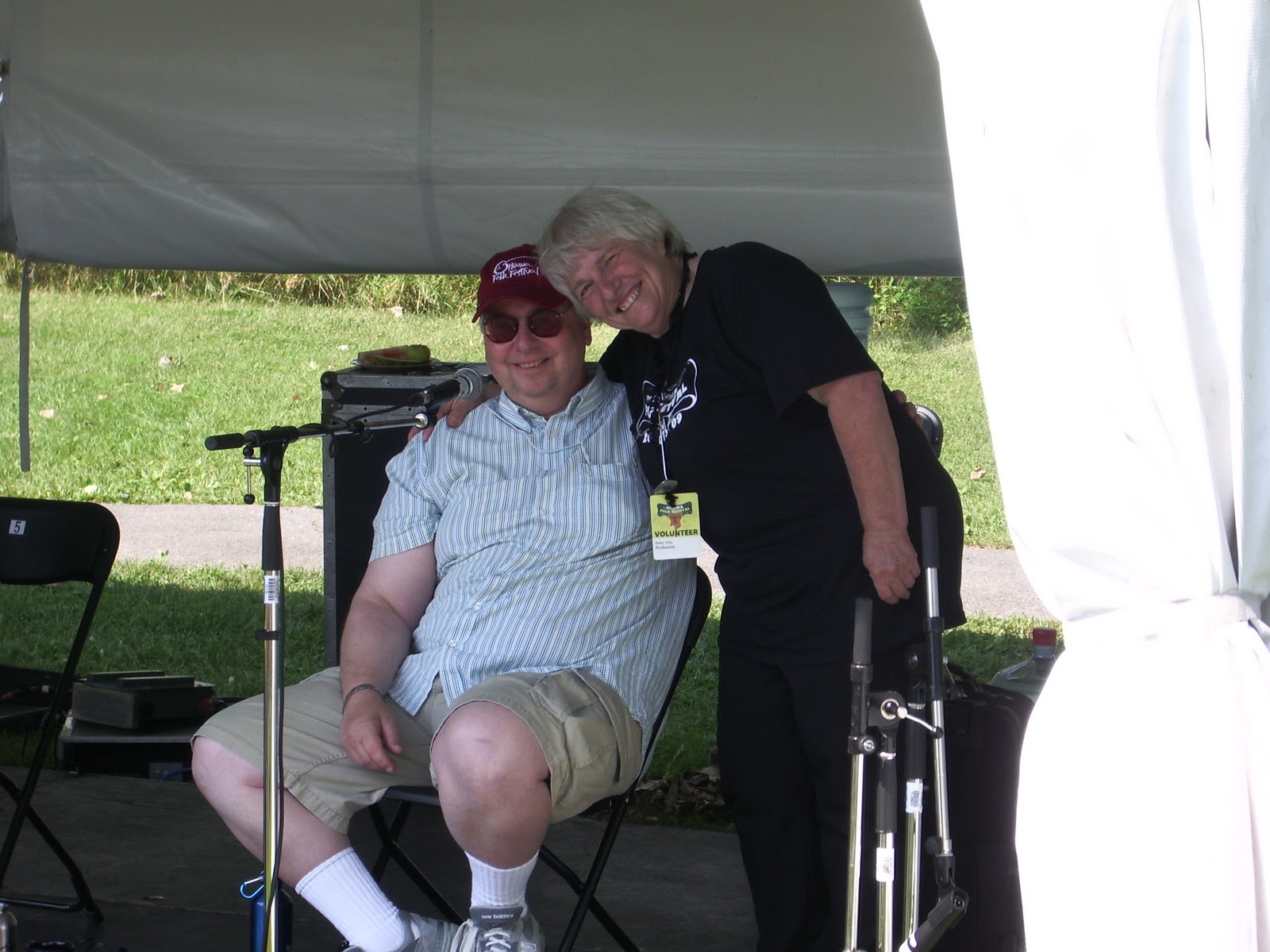
Pictured: Mike Regenstreif and Sonny Ochs at the 2009 Ottawa Folk Festival.

--Mike Regenstreif

Sunday, March 6, 2011

Lucinda Williams – Blessed

LUCINDA WILLIAMS
Blessed
Lost Highway
lucindawilliams.com

I read a review of Blessed, Lucinda Williams’ new CD, before I had a chance to actually sit down and listen to the album. The critic gave the album a lukewarm review, damning it with some faint praise while seeming to lament that Williams is currently happy in her life; suggesting that she writes much better songs when she’s unhappy.

Reading the review, I worried I wouldn’t like the album. I needn’t have. Blessed – like virtually every other album Williams has released – is a superbly crafted set of songs. Being of a similar age to Williams, it’s more than OK with me that she’s writing mature songs that reflect the life experiences of our generation.

And, in any case, many of the songs on Blessed do reflect the kinds of themes of anger and sadness that Williams has always dealt with so brilliantly.

The CD opens with “Buttercup,” an angry kiss-off to a former lover or friend set to an intense, rocking arrangement. It’s followed by the quieter “I Don’t How You’re Livin’,” in which Williams expresses sadness at the fact that the person she’s singing about – perhaps the same former lover or friend of the previous song – has isolated him or herself from her.

Several songs deal with questions of mortality and death. In “Copenhagen,” she’s far from home trying to make sense of a death of someone who was obviously close. In “Seeing Black,” apparently inspired by the death of songwriter Vic Chesnutt, she addresses a series of rhetorical ‘why’ and ‘how’ questions to someone who has committed suicide; while in “Soldier’s Song,” Williams movingly contrasts the life of a soldier about to die in battle with that of his wife and child waiting at home.

I also really like the more positive songs on the album. “Born To Be Loved,” is kind of a love song, but, more than that, it’s a song of affirmation about what it means to be human. “Blessed” and “Awakening” continue that affirmation finding life’s blessings in all of the ordinary and extraordinary encounters that we experience in life.

And in a pair of beautiful love songs, “Sweet Love,” and “Kiss Like Your Kiss,” Williams reflects the happiness that comes with true and lasting love.

Williams only rocks hard on a couple of the dozen tracks. Most of the arrangements are the kind of trademarked acoustic settings that allow a listener to be transported by Williams’ luxuriant voice, and by her perceptive words and sweet melodies.

--Mike Regenstreif