Showing posts with label Marjorie Mazia Guthrie. Show all posts

Monday, July 16, 2012

Mike + Ruthy – The NYC EP


MIKE + RUTHY
The NYC EP
Humble Abode Music

“My New York City,” the lead track on Mike + Ruthy’s new and all-too-short six-song set, The NYC EP, is yet another great and previously-unheard song from the Woody Guthrie Archives. It’s a beautiful love song that celebrates New York City, and more particularly celebrates New York City as the place where Woody met his second wife, Marjorie (Greenblatt) Mazia, and where they lived and raised their young family. Listening to the lyrics, which are not currently listed at woodyguthrie.org, I assume they probably date from the mid-to-late-1940s when the family was living in the Coney Island section of Brooklyn.

Interestingly, the songwriting credits list words and music by Woody Guthrie with additional music by Michael Merenda and Ruth Ungar. This suggests there was a known tune that Woody used for the song – as opposed to most of the previously unheard songs from the Archives that various artists have been setting to music over the past two decades. In any case, it’s a lovely song, perhaps the best track yet from Mike and Ruthy.

In fact, the EP is probably the best CD yet from Mike and Ruthy in their post-Mammals career as a duo. Another highlight is their version of Lil Green’s 1940 classic blues, “Romance in the Dark,” featuring a sexy vocal by Ruthy and her nimble playing on a resophonic uke while Mike backs her up on harmonica.

The other four songs are originals, three written by Mike, one by Ruthy. My favourite of these is Mike’s “On My Way Home,” a banjo-driven, old-time-meets-rock-‘n’-roll arrangement which uses home as a metaphorical place to return to after a difficult period in life.

Another favourite is Ruthy’s “Oh Mama,” a fun-blues seemingly inspired by their infant son’s not wanting to take a nap.


I'm now on Twitter. twitter.com/@mikeregenstreif


I'm also on Facebook. www.facebook.com/mikeregenstreif

--Mike Regenstreif

Sunday, May 13, 2012

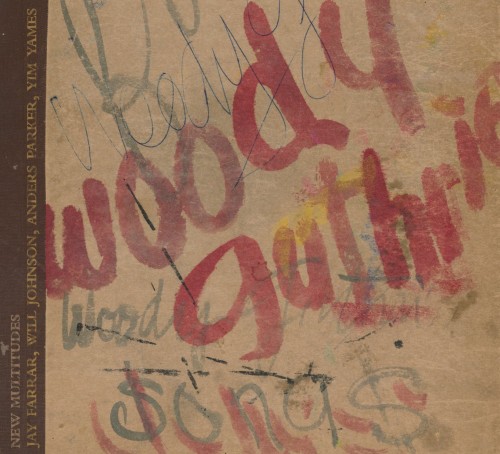
Jay Farrar, Will Johnson, Anders Parker & Yim Yames – New Multitudes


JAY FARRAR, WILL JOHNSON, ANDERS PARKER & YIM YAMES
New Multitudes
Rounder Records

Woody Guthrie’s astounding writing career – not just songs; also books, poems, letters, newspaper columns and more – was brief, less than 20 years. He began in the mid-1930s and it was over by about 1954 when he was hospitalized with Huntington’s disease, the hereditary neurological disease that eventually robbed him of his life in 1967 at just 55.

It wasn’t too much time after Woody’s death that I, as a teenager, discovered his songs, books and records. I’ve been listening and reading for about 45 years. More recently, I’ve been fascinated with the work that Nora Guthrie has been doing to bring the thousands of her father’s unheard songs back to life.

When I first began listening to Woody Guthrie records, and to others doing Woody Guthrie songs, back in the 1960s, it was commonly said that Woody was so driven to write that he must have written about a thousand songs. Through Nora’s work at the Woody Guthrie Archives, we now know there were many more songs, about 3,000, and most of them have never been heard. Whatever tunes or melodies Woody wrote or adapted for them are forgotten or were never known.

Over the past two decades, some of these songs have come to life in new musical settings by a wide variety of artists – some in album-length projects, some in one-off settings. Among my favourite album-length projects have been Wonder Wheel by the Klezmatics, Ticky Tock by the German artist Wenzel, and last fall’s Note of Hope by various artists in collaboration with Rob Wasserman. What never fails to astound me is how wide-ranging Woody’s writing was – all of these newly come-to-light songs revealing more clues into the Guthrie mystery – and how adaptable his writing was to so many different styles and musical genres and how it continues to speak to very varied artists.

The four artists featured on New Multitudes are alt-country and indie rock veterans Jay Farrar, Anders Parker, Will Johnson and Yim Yames (Jim James). Their settings range from folkish to full tilt rock ‘n’ roll and the album is available in two versions: a single CD with 12 songs and a 2-CD deluxe set with an additional 11.

The CD booklet – at least in the deluxe version – has reproductions of Woody’s original lyrics to the 23 songs. And while a few songs are not dated, they date from as early as 1938 to as late as December 1954 when Woody was already hospitalized. It’s fascinating to me, as someone who is familiar with the narrative of Woody’s life, to listen to the songs within the context of when they were written.

Several were written during World War II when Woody served in the merchant marine and army. “Hoping Machine,” written in June 1942, and set to music here by Farrar, are words of advice and inspiration that seem simultaneously universal to everyone and particular to Woody himself. “When I Get Home,” written in 1944 and set to music by Parker, is written from the perspective of a soldier who’s seen too much of war but who also knows there’s much to be done in the fight for social justice at home. And “Atomic Dance,” written about seven weeks after the atomic bombs were dropped on Hiroshima and Nagasaki, and set to music here by Farrar, would seem to be a metaphorical attempt to understand the dawning of the nuclear age.

Several others were written during Woody’s Coney Island period, in the years after the War, when he was married to Marjorie Mazia Guthrie and they were raising their young children (including Arlo and Nora).

Among them is “Fly High,” set to music by Parker, perhaps the sweetest sounding song on the two CDs. It seems to be sung by a man who has walked out on love but is returning again, like he has before, to the love he regrets having messed up. Another is “My Revolutionary Mind,” set to music by Yames, in which Woody iterates his need for a woman who shares his political views.

A bunch of the songs date from the early-1950s, when Woody, already showing signs of Huntington’s disease spent time in California. Earlier songs from this period, like “Old L.A.,” written by Woody in 1950 and set to music by Parker are more lucid than some of the later ones. “Old L.A.,” actually sounds like it could have been an Eagles song from the 1970s.

But, Woody’s own understanding that something is wrong shows through in later songs. In “Talking Empty Bed Blues,” written in 1952 and set to music by Yames, Woody writes, “My neighbors all see me stumblin’ home; They c’n see there’s something pretty bad wrong.”

Another from that period is “San Antone Meat House.” The ‘meat house’ in question here is a brothel and the song is sung from the perspective of a prostitute whose life has pretty much been destroyed by her years in the meat house. It’s a scarier, more graphic step inside the more familiar house of the Rising Sun.

Scarier still is “Dope Fiend Robber,” written by Woody in December 1953 and set to music by Parker. It’s sung from the perspective of a strung out junkie who will stop at literally nothing to feed his jones and is filled with the kind of language and characterizations they now warn us about on cable TV movie channels. I have, of course, heard Woody’s recordings of traditional outlaw ballads like “Bad Lee Brown (Little Sadie)” and his own outlaw ballads like “Pretty Boy Floyd,” but those criminals were almost choir boys in comparison to the dope fiend robber.

A couple of songs written after Woody was hospitalized are particularly fascinating.

In “No Fear,” written December 8, 1954 at Brooklyn State Hospital, and set to music by Johnson, Woody writes like a man at peace with the inevitable given his illness, that he’s ready for death – a death that would actually be 13 years in coming.

And, in “Old Kokaine,” written that same month and set to music by Farrar, he writes like a man close to death, but not at peace thanks to the substances that he thought might have numbed the pain over the years of his deterioration – but didn’t.

The effects of Huntington’s disease can even be seen in the reproductions of Woody’s handwritten lyrics in the CD booklet. Compare his handwriting on those two songs to his handwriting of even a year or two earlier and then to the much earlier work.


There is much more in other songs beyond those I’ve mentioned. The lyrics on most of the songs on the album date from a period in which the United States was in the grip of McCarthyism and striding almost blindly into the age of nuclear proliferation and there are references to such developments in several songs.

As these songs – and others that have surfaced from the Archives over the past 20 years – reveal, Woody Guthrie was a much more complex thinker and writer than we ever could have known. Each of these projects of songs from the Archives fills in just a little bit more of our understanding.

Note: This review is based on the 2-CD deluxe edition of New Multitudes. A single CD version (the first of the two CDs in the deluxe version) is also available. But some of the songs I’ve mentioned are only available in the deluxe version.

Pictured: Mike Regenstreif, Nora Guthrie, Kris Kristofferson and Jimmy LaFave talk about the enduring legacy of Woody Guthrie at the 2007 Ottawa Folk Festival.

I'm now on Twitter. twitter.com/@mikeregenstreif

I'm also on Facebook. www.facebook.com/mikeregenstreif

--Mike Regenstreif

Sunday, November 27, 2011

Various Artists – Note of Hope: Woody Guthrie & Rob Wasserman, a collaboration in Words and Music

VARIOUS ARTISTS
Note of Hope: Woody Guthrie and Rob Wasserman – a collaboration in words and music
429 Records

“The note of hope is the only note
That can keep us from falling to the bottom of the heap of evolution
Because, largely, about all a human being is anyway
Is just, a hoping machine.”

-Woody Guthrie, Notes About Music, 3/29/1946

During the almost-14-year run of the Folk Roots/Folk Branches radio show on CKUT in Montreal, I did a bunch of special programs devoted to the songs of Woody Guthrie.

Almost 11 years ago, on January 4, 2001, Nora Guthrie, Woody’s daughter and director of the Woody Guthrie Archives, joined me on one of those shows to talk about Woody, the archives and the various projects she had done, or had in the works, to bring the thousands of unheard songs in the archives to life.

One of the projects she mentioned was a multi-artist collection being spearheaded by the great bassist Rob Wasserman. I was already a big fan of Rob’s playing and of his Duets album for which he collaborated with a different artist on every track, so the Woody Guthrie project was something I quickly began looking forward to.

Years passed since that radio show. When I’d see Nora over the years, she’d tell me the project was still ongoing. Finally, Note of Hope is out, released in conjunction with celebration leading to the centennial of Woody’s birth on July 14, 2012.

Rob Wasserman’s bass playing is the heartbeat of this collection, and the soul is Woody Guthrie’s writings, dating from his New York – particularly Brooklyn – years of 1942 to 1954.

It’s an eclectic collection of artists and an eclectic range of material that Rob and Nora have assembled for Note of Hope. There are artists rooted in folk, rock, jazz and hip hop – or various combinations thereof – and the songs, mostly set to music by the individual artists themselves, or in collaboration with Rob, stretch far and away, both lyrically and musically, from the standard Woody Guthrie canon. In addition to having been a prolific songwriter, Woody was also a prolific prose writer and I'm sure some these pieces were not written as songs. Several of the most compelling tracks are performed as spoken word pieces with musical backing.

The spoken word tracks, and a couple of others that are kind of sung-spoken, remind me of Jack Kerouac’s recorded readings with musical backing.

Among the spoken word pieces is “Voice,” performed by Ani DiFranco, a Coney Island meditation on how it is not real, authentic, everyday people reflected in popular culture – something that’s not much different 60 or 70 years later.

Another is “I Heard a Man Talking,” a reading by the late Studs Terkel, the legendary Chicago radio interviewer and oral historian. The piece, written in 1943, is a story that could have come out of Kerouac’s On the Road, written almost a decade later. It makes me wonder if Kerouac’s stream-of-consciousness writing style was at least partially inspired by Woody’s writing.

And then there’s “There’s a Feeling in Music,” read by Pete Seeger on top of a banjo and bass arrangement composed and played Tony Trischka and Rob. Written in 1942 just two years after Woody and Pete met for the first time in New York City, it is a beautifully written rumination on why music and songs are so important and so much a part of our lives.

“The Debt I Owe,” set to music with some of his additional words by Lou Reed is almost a talking song too. The narrator walks around Coney Island – where Woody lived with wife Marjorie Mazia Guthrie and kids Arlo, Joady and Nora – ruminating on money troubles in a way that seems to so reflect the burdens of so many in our own 21st century economic crisis. But, there’s another layer to the song. The real debt is not about money, it’s about the times we’re living in – “the bell is ringing out danger,” Lou sings (and a line Lee Hays and Pete Seeger would use a few years later) – and the people we love and sometimes hurt, and owe so much to.

Other highlights include “Wild Card in the Hole,” set to music and sung by Madeleine Peyroux, another song that seems as reflective of our own times as of 1949 when Woody wrote the words; and “Old Folks,” set to music and sung by Nelly McKay, in which the narrator muses on the weariness and accomplishment of old age and the optimism of youth.

The finale, “You Know the Night,” set to music by Rob and Jackson Browne, and sung by Jackson, is an amazing 15-minute tour-de-force in which Woody vividly recalls the night he met Marjorie. Written in 1943, it almost presages songs like “Sad Eyed Lady of the Lowlands” that Bob Dylan would start writing two decades later.

The performing artists in this collection are of our time, but I never cease to be astounded how so much of Woody’s writings, from six or seven decades ago, seems to be as much, or more so, of our time as his.

--Mike Regenstreif