Saturday, January 12, 2013

David Olney – Body of Evidence: Film Noir, The Stone, Robbery & Murder


DAVID OLNEY
Body of Evidence: Film Noir, The Stone, Robbery & Murder
Deadbeet Records 
davidolney.com


I’ve long thought of David Olney as one of the finest of songwriters and have loved almost all of his many albums and regret that I’ve only ever had one chance to see him live – a powerful 20-minute set at a Rounder Records showcase at a Folk Alliance conference I was MCing in the 1990s. Over the course of 2011 and 2012, David released a series of three, thematic EPs ranging from 20 to 30 minutes each and including both new and reinterpreted songs from his rich catalog. The three EPs are available individually or now boxed together as Body of Evidence. The three song-cycles feature rich storytelling built around well developed characters.

The five songs on Film Noir evoke the moodiness of classic black-and-white crime movies from the 1940s and ‘50s. Whether it’s the mystery of disappearing characters, the scene at a seedy hotel or capturing the ruthlessness of selfish ambition and broken dreams, these songs unfold vividly in the listener’s imagination.

The six songs on The Stone offer observations on the New Testament legend of Jesus’ last entry into Jerusalem and crucifixion from six different perspectives and a lens that incorporates the ancient texts, varied interpretation and David’s own imagination. One song sees the story from the perspective of a religious con man turned disciple, another imagines an anthropomorphic commentary from the donkey who bore Jesus into Jerusalem. Another is sung in the questioning voice of Barabbas, the condemned prisoner who is set free just before his own execution on the cross, while yet another is from the perspective of a Roman soldier after the body has seemingly disappeared.
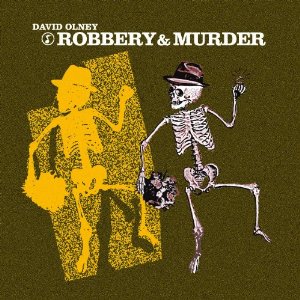
The six songs on Robbery & Murder – there are also two brief instrumental interludes – offer three alternative views each to two love stories. The story of Betty and Dupree – in which Betty demands a diamond ring and Dupree, without the means to buy her one, robs a jewelry store only to get caught – has been sung about in countless versions by countless folk and blues artists. Here David offers his own retelling in “Go Down Dupree” and “Gold Diamond Ring,” the latter sung from the anthropomorphic perspective of the ring itself, and with a version of R&B artist Chuck Willis’ adaptation of the traditional song.

The other story offers three takes on a murder of a woman named Delia who seems to me partially inspired by the Delia of many traditional folk and blues songs and perhaps partially by the Delia at the centre of “Sweat,” a short story by Zora Neale Hurston. One song is from the perspective of Delia’s lover, another is narrated by the husband who killed her, and the last is sung by Delia’s ghost, still waiting by the river for the man she loves.

Each of the three EPs has a distinctive sound suited to the different themes. Film Noir often feels like late night jazz, The Stone has quieter arrangements and Robbery & Murder is tougher and blusier. All three are compelling listening.

Find me on Twitter. twitter.com/@mikeregenstreif

And on Facebook. facebook.com/mikeregenstreif

--Mike Regenstreif

Sunday, January 6, 2013

Jory Nash – Little Pilgrim


JORY NASH
Little Pilgrim
Thin Man

Little Pilgrim is Jory Nash’s seventh album since his 1998 debut. As I noted in a 2007 review of his Folk Jazz Blues & Soul in Sing Out! magazine, I’ve enjoyed watching – and particularly listening – as the Toronto-based singer-songwriter has matured into an artist of substance.

Jory had come a long way as a singer-songwriter when I made that observation almost six years ago and he’s come further since. Little Pilgrim is an elegant collection of well-crafted songs – many of which recall the early-1970s when artists like James Taylor, Paul Simon and so many others blended folk and pop music influences to create songs that were at once both personal and universal and which reached beyond the insipidness typical of most popular music.

Among my favourite songs on Little Pilgrim are “The Long Siesta,” in which Jory’s narrator, a criminal who’s been lying low among the tourists in the sun, plots his return to action; “Truth,” a sweet, jazzy piano-based late-night reflection influenced – as Jory acknowledges – by early Tom Waits and Billy Joel; and “Take Me Back to Monticello,” inspired by a childhood trip taken with his family.

Also among the most impressive songs are “Little Pilgrim,” in which the character finds some kind of redemption in a religious experience; “Sally,” a plea for forgiveness inspired by a night of Randy Newman songs; and “Helicopters Circling,” an angry commentary about what happened to civil liberties in Toronto in 2010 when the G20 Summit came to town.

Each song is meticulously and individually arranged with outstanding work by Jory and a group of studio musicians and harmony singers including Jason Fowler, David Matheson, Christine Bougie, co-producer Chris Stringer, Lori Cullen and Suzie Vinnick.

Find me on Twitter. twitter.com/@mikeregenstreif

And on Facebook. facebook.com/mikeregenstreif

--Mike Regenstreif

Thursday, December 13, 2012

Top 12 for 2012


Here are my picks for the Top 12 folk-rooted or folk-branched albums of 2012  (including reissues). I started with the list of more than 400 albums that landed on my desk over the past year and narrowed it down to a short list of about 30. I’ve been over the short list a bunch of times and came up with several similar – not identical – Top 12 lists. Today’s list is the final one. The order might have been slightly different, and there are several other worthy albums that might have been included, had one of the other lists represented the final choice. I also took a bit of liberty by listing four reissues by one artist as a single choice.

1. Woody Guthrie, Woody at 100: The Woody Guthrie Centennial Collection (Smithsonian Folkways). The book and the third CD, which contains much previously unreleased material, make this 3-CD boxed set essential for Woody collectors. The entire set also makes for a great introduction for Woody novices to the great folksinger and songwriter in this year marking the 100th anniversary of his birth.


2. Leonard Cohen – Old Ideas (Columbia). Like so much of Leonard Cohen’s best work, there are layers and layers of meaning and understanding in these songs that I think will continue to reveal themselves over a period of years of repeated listening.


3. Bob Dylan – Tempest (Columbia). This is the work of a master songwriter – the master songwriter of our time – informed by half a century of his own work and by the music of what Greil Marcus called “old weird America,” the folk music and folk-rooted blues and country music which developed in various regions before spreading everywhere via recordings and migratory performers.


4. Stan Rogers – Turnaround/Between the Breaks … Live!/Northwest Passage/From Fresh Water (Borealis). Remastered and reissued versions of the final four of the five original albums Stan Rogers – in my opinion, Canada’s greatest folksinger and songwriter – recorded for his family owned record label (the first in the series was reissued in 2011).


5. Tom Russell – Heart on a Sleeve (Frontera). A remastered and reissued version of the great solo debut  album – with six bonus tracks – by the artist who I’ve come to think of as the greatest songwriter of my generation.


6. Eric Bibb – Deeper in the Well (Stony Plain). Mostly recorded in Louisiana with musicians who add some Cajun and Creole influences, this is yet another inspired and inspiring set by the great acoustic blues and folk artist.


7. Maria Dunn – Piece By Piece (Distant Whisper). This suite of eight songs inspired by the waves of women immigrants who worked at the GWG clothing factory in Edmonton between 1911 and 2004 – and which is sung from some of their perspectives – is one of this year’s folk music masterpieces.


8. Anne Hills – The Things I Notice Now: Anne Hills Sings the Songs of Tom Paxton (Appleseed). This is an excellent set of some of the finest songs written by one of our finest songwriters – sung by one of our finest interpretive singers. Tom Paxton joins Anne for three duets.


9. Lucy Kaplansky – Reunion (Red House). Many of these songs movingly and poignantly reflect on family relationships and the continuity of generations.


10. Kim & Reggie Harris – Resurrection Day (Appleseed). Filled with glorious harmonies, this album inspires with a message that we are all important and vital parts of a world that is so much bigger than any of us.


11. Kathy Mattea – Calling Me Home (Sugar Hill). A moving folk music album by a one-time country music hit-maker which explores her deep roots in the Appalachian Mountains.


12. Hans Theessink & Terry Evans – Delta Time (Blue Groove). A second superb collaboration by the always excellent Hans Theessink, a Dutch blues singer based in Austria, and Terry Evans, a fine blues and gospel singer originally from Mississippi.


Find me on Twitter. twitter.com/@mikeregenstreif

And on Facebook. facebook.com/mikeregenstreif

--Mike Regenstreif

Wednesday, December 12, 2012

Stan Rogers – Northwest Passage; From Fresh Water


STAN ROGERS
Northwest Passage
Fogarty’s Cove/Borealis 
borealisrecords.com/artists/stan-rogers/

STAN ROGERS
From Fresh Water
Fogarty’s Cove/Borealis
 borealisrecords.com/artists/stan-rogers/

Northwest Passage, first released in 1981, and From Fresh Water, first released posthumously in 1984, were the final two albums recorded by Stan Rogers for Fogarty’s Cove, his family-owned record label. They are also the final two installments in Borealis Records’ project of releasing remastered versions of the original albums from the tragically too-short career of the artist I’ve long thought to be Canada’s greatest folksinger and songwriter.

These albums also continue Stan’s ongoing project to create song-cycles set in Canada’s various regions – something he began to do on Fogarty’s Cove when he wrote and sang about Atlantic Canada and its people. On Northwest Passage, he wrote and sang about the prairies and the north; on From Fresh Water, about Ontario, particularly the Great Lakes region.

Northwest Passage begins with the anthemic title song, a vivid portrait of Stan driving west across the country recalling the early explorers who searched for the elusive Northwest Passage connecting the Atlantic and Pacific Oceans through the arctic – centuries before global warming actually seems to have made a Northwest Passage feasible. Sung a cappella, the powerful song has proven to be one of the most enduring classics in a song catalog filled with enduring classics.

On other songs, Stan writes as empathetically about the people of the west and north as he’d already done so successfully about Atlantic Canadians.

In “The Field Behind the Plow,” he sings to and about an everyman farmer insightfully and authentically capturing his hopes and dreams, and his sometimes cruel realities.

In “Lies,” he sings, again insightfully and authentically, about a farmer’s wife and the hard life she leads. I’ve always thought of “The Field Behind the Plow” and “Lies” as companion songs married to each other.

“Night Guard” is a modern-day cowboy song worthy of Ian Tyson about a rodeo cowboy – now too old for the game – making a living protecting a cattle herd from rustlers, and “Canol Road” is an exciting, vividly cinematic song about a guy in the Yukon, crazy with cabin fever, who just had to get out and get that drink, no matter what the conditions, and no matter the price he’d have to pay.

A couple of the best songs on Northwest Passage blend the west with Stan’s eastern roots. In “The Idiot,” Stan sings in character as one of the countless Maritime boys who left home to work in the Alberta oil fields. And in “Free In the Harbour,” he sings about Newfoundlanders, stopping in Winnipeg on their way to Alberta, or sitting in the taverns of Edmonton and Calgary, nostalgically remembering home, “where the whales make free in the harbour.”

From Fresh Water begins with “White Squall,” which Stan sings from the perspective of an experienced Great Lakes shipman, used to the fury of lake storms, commenting on a much younger mate who, tragically, didn’t heed his warnings.

One of the finest songs on the album is “Lock-keeper,” sung from the perspective of such a man on the St. Lawrence Seaway. In some ways, I think “Lock-keeper” is related to “Northwest Passage.” In the latter song, Stan sings about leaving “a settled life” for the life of the adventurer. But, in “Lock-keeper,” he sings about the greatness of that settled life – of love and family – in contrast to the ultimate loneliness of the adventurer.

One of the most powerful songs on the album is “Flying,” ostensibly a hockey song about all the young players who dream of making it to the NHL while only a small, select few ever do. In reality, it’s an allegory about reaching for any kind of a star knowing so few will get there.

And, in a very sadly, prophetic line in “Flying,” Stan sang about “go up flying and going home dying” – something that tragically happened to him just a few months after writing the song.

Other favorites include “Tiny Fish for Japan,” which captures the feelings of Great Lakes fishers whose catch is bound for foreign markets, “The Last Watch,” a sad lament about a lake steamer about to be scrapped, and “The House of Orange,” a quiet, but very powerful commentary about the refusing, as an Irish descendant, to be part of the centuries-old conflict in Ireland that still raged in 1983.

As with Fogarty’s Cove, Turnaround and Between the Breaks … Live, as well as The Very Best of Stan Rogers, the remastered sound makes Northwest Passage and From Fresh Water sound better and fresher than they did as LPs or in their first issue on CD and are potent reminders of the tremendous singer and songwriter lost in that airplane fire almost 30 years ago. He was an artist with so much more to accomplish.

Kudos to Borealis Records for reissuing the albums, to Paul Mills, who produced the albums and supervised the reissue remastering, and to Ariel Rogers, Stan’s widow, who has kept the music in print over these many years.

I think it’s also important to acknowledge the important contributions of Garnet Rogers, Stan’s younger brother, and Valerie Rogers, his mother.

Garnet’s playing and/or singing can be heard on almost every track of all five of the albums – as it was at almost every gig Stan played in the last 10 years of his life. On more than one occasion, over a late-night beer, Stan told me that Garnet was his biggest musical influence.

And Valerie, who passed away this past summer, was the driving force behind getting most of these records made and into the hands of his growing legion of fans during his touring years. Stan expressed his tremendous appreciation for his mother’s efforts at virtually every concert I saw him do – at least since Turnaround came out in 1978.

Find me on Twitter. twitter.com/@mikeregenstreif

Or on Facebook. facebook.com/mikeregenstreif

--Mike Regenstreif