Saturday, June 2, 2012

Chris Rawlings – Autumn Gold


CHRIS RAWLINGS
Autumn Gold

Chris Rawlings was one of my favourite local singer-songwriters when I first started hanging out on the Montreal folk scene back around 1969. He was then in the early stages of his solo career after spending a few years as part of a band called Rings and Things. Forty years ago this fall, when I started my first concert series at Dawson College in Montreal, Chris headlined my second concert presentation. And when I started running the Golem Coffee House in 1974, Chris was one of my frequently-presented artists. Some of the material on this collection of live tracks and previously unreleased studio recordings dates from those days.

Among the highlights are a couple of topical songs written from perspective of a Quebec anglophone. “Farewell to Quebec,” recorded live in Toronto in 1989, is a bittersweet farewell that captures well the feelings of so many people caught up in great anglo exodus from Quebec that became a tidal wave in the 1970s and ‘80s (and which still continues to this day).

And “Hey René,” recorded in 1976, is a reaction to the election of Quebec’s first separatist government under René Lévesque. One of the most prophetic lines in the song says, “What will you do when the contract comes due and the union bosses that supported you want more?” We found out the answer to that in 1982 when Lévesque and his finance minister, Jacques Parizeau, rolled back public sector wages by 20% in what was the most draconian anti-labour legislation in Canadian history.

Other highlights include a 1972 recording of “House of D,” covered back in the day by Christopher Kearney, a folk-rock song that reaches out to a teenage girl caught up in a cycle of abuse and detention and Chris and Paul Lauzon’s dreamy setting of William Butler Yeats’ “Lake Isle of Innisfree” recorded live in 1998 (but which I remember from back in the 1970s).

I particularly liked hearing Chris’ versions of two of the late Wade Hemsworth’s classic songs. “The Log Driver’s Waltz,” recorded in 1972, includes harmonies from Wade himself and three original members of the Mountain City Four: Anna McGarrigle, Peter Weldon and Jack Nissenson, while the solo version of “The Wild Goose,” recorded at the Wade Hemsworth Tribute Concert in Montreal in 2002, is beautiful and haunting.

The album ends with a rollicking version of Chris’ own classic, the tongue-twisting “Pearl River Turnaround” recorded live at Expo ’86 in Vancouver with fiddler Christophe Obermeir.

Chris precedes “Pearl River Turnaround” with a song written and sung by Obermeir at Expo ’86 on which Chris backs him on recorder. As the one track featuring a different lead singer, it interrupts the flow and unnecessarily throws the album off its Rawlings-track.

Overall, Autumn Gold nicely rekindles some fond musical memories from my salad days.

Pictured: Chris Rawlings and Mike Regenstreif at the 2007 Branches & Roots Festival in Ormstown.

I'm now on Twitter. twitter.com/@mikeregenstreif
 

I'm also on Facebook. www.facebook.com/mikeregenstreif

--Mike Regenstreif

Tuesday, May 29, 2012

Doc Watson 1923-2012


The great Doc Watson – the complete folk musician if there ever was one – passed away today at 89. When he began recording in the early-1960s, Doc set the standard for every virtuoso acoustic guitarist who would follow after. And Doc was not just a great flatpicker, he was an incredible fingerpicker, a great banjo frailer, and as warm a singer as you can imagine with a repertoire that spanned traditional and contemporary folk music, bluegrass, blues, rockabilly and more.

I can still vividly remember the first time I saw Doc play. I was 16 and sitting up close to the stage, mesmerized, in 1970 at the Back Door Coffee House in Montreal as Doc and Merle Watson – billed as “Doc Watson & Son” – played an amazing concert to 100 or so of us packed into the small room. If I remember correctly, it was during the October Crisis and there were soldiers on the street outside.

I couldn’t begin to imagine all the many hours I’ve spent listening to Doc – every one of those hours worthwhile.

Tonight, I guess, we’ve all got those deep river blues as Doc Watson takes his long journey.

For more on Doc Watson, see this memorial page at Folklore Productions – Doc’s agents for almost his entire career.


--Mike Regenstreif

Saturday, May 26, 2012

Montreal: Folk Festival on the Canal June 14-17


Peter Yarrow
Regretfully, other commitments in other cities mean I won’t be helping to MC the Folk Festival on the Canal in Montreal, this year from Thursday, June 14 through Sunday, June 17. This will be the first time I've missed doing that since the festival began.

The little folk festival that could – put together by Matt Large and Rebecca Anderson of Hello Darlin’ Productions and Carl Comeau of Hyperbole Music  – grew nicely over its first four years. This year, the fifth annual looks to be the best yet.

Jim Kweskin
The festival begins with indoor concerts on the Thursday and Friday evenings at the Georges Vanier Cultural Centre (2450 Workman) featuring legendary veterans of the 1960s folk scene still making vital music today.

Thursday evening features Peter Yarrow – best known, of course, from his almost-half-a-century as one-third of Peter, Paul and Mary, the most successful and most enduring group of the folk-boom era.

Friday evening’s concert is with the great jug band leader Jim Kweskin who will be backed up by the Ever Lovin’ Jug Band – former Lake of Stew members Brad Levia and Julia Narveson.

Notre Dame de Grass
I wouldn’t have missed either Peter or Jim’s shows if I could have been in Montreal that week.

On Saturday and Sunday, the festival moves over to Ilot Charlevoix (corner of St. Patrick and Charlevoix) for two full days of concerts, hanging out and other fun featuring such excellent artists as Notre Dame de Grass, Dala, Rob Lutes, David Sherman, Joey Wright & Carolyn Mark and many others.

It should be a great four days of folk festivallng in Montreal. Sorry I can't be there.


I'm now on Twitter. twitter.com/@mikeregenstreif
 
 I'm also on Facebook. www.facebook.com/mikeregenstreif

--Mike Regenstreif

Friday, May 25, 2012

Pete Seeger – The Complete Bowdoin College Concert 1960


PETE SEEGER
The Complete Bowdoin College Concert 1960
Smithsonian Folkways
 
Back in May of 1999, I did a long radio interview with Pete Seeger on the occasion of his 80th birthday. It was a fascinating look back at a remarkable folk music career which, by then, had stretched over the course of six decades. By now, you can add another 13 years onto that amazing time frame.

Pete told me was that he considered the countless college and community concerts he did during the time he was blacklisted in the 1950s and ‘60s to be, perhaps, the most important work he ever did. Those concerts – and Pete’s seemingly endless stream of Folkways LPs – introduced thousands to folk songs, folk music, and most particularly, to the joys of music making and communal music making. A Pete Seeger concert was always about people making music together. Pete may have been alone on stage, but every person in the audience was always an essential component to his music-making.

This time period was surely a difficult one for Pete. The McCarthy-era blacklist effectively banned Pete – and many others – from mainstream concerts, radio, record labels and network television. Hanging over his head was a contempt of Congress indictment for refusing to answer questions about his political beliefs before the House Un-American Activities Committee in 1955 (he was tried, convicted and sentenced to 10 years in prison on the charge in 1961; the case was thrown out on appeal), and right wing groups would often picket his concerts or try to prevent them from taking place.

While there are any number of complete Pete Seeger concert albums that have been released over the years, The Complete Bowdoin College Concert 1960, released 52 years after it was recorded at a Maine college, becomes the earliest such example. And although it dates from a few years before I started going to Pete Seeger concerts, I’ve been to enough of them over the past 45 years (and having listened to all of the other complete concert recordings that are out there) to know that it must have been a fairly typical example of a 1960-era Pete Seeger concert: topical songs, traditional folk songs, some of his own material, some borrowed from other songwriters, some international folk songs, some Lead Belly, some of the folk hits of Pete’s old group the Weavers. The only thing that surprises me is that he sang no Woody Guthrie songs that night. In that 1999 interview, Pete told me he was on a mission in those days to introduce the songs of Lead Belly and Woody Guthrie to new generations.

Most of the songs Pete sang that night at Bowdoin are familiar standards of his repertoire. Among them are “The Bells of Rhymney,” “The Water is Wide,” “Deep Blue Sea,” “Wimoweh,” an early version of “Where Have All the Flowers Gone,” the Israeli song “Tzena, Tzena, Tzena,” “Goodnight Irene” and “Viva La Quince Brigada.” But, as I noted in my review for another complete concert recording, Live in ’65, “despite the fact that I’ve heard Pete’s various recordings of such songs hundreds, if not thousands, of times, I never tire of hearing them again, and of hearing the individual nuances of a particular performance.”

There are also a few songs I’m not sure I’ve heard Pete sing before like Ernie Marrs’ “Quiz Show,” a commentary on the Twenty One scandal from the 1950s set to the tune of “Sweet Betsy from Pike,” the sea chantey “Hieland Laddie,” and Big Bill Broonzy’s “I Had a Dream.”

Certainly among the highlights is a really bluesy version of “Summertime” that seems much more powerful than his American Favorite Ballads studio version.

Like any other Pete Seeger concert I’ve attended, and there have been many, and almost every Pete Seeger record I’ve listened to, and there have been many more of those, The Complete Bowdoin College Concert 1960 cannot fail but to be an inspiring experience. And, like the audience 52 years ago, you will be singing along to many of these songs as you listen. You can’t help yourself.

I'm now on Twitter. twitter.com/@mikeregenstreif

I'm also on Facebook. www.facebook.com/mikeregenstreif

--Mike Regenstreif

Thursday, May 17, 2012

John McCutcheon – This Land: Woody Guthrie’s America


JOHN McCUTCHEON
This Land: Woody Guthrie’s America
Appalseed Productions

This coming July 14 will be the 100th anniversary of the birth of Woody Guthrie, one of the most important and influential folksingers and songwriters of the 20th century. A number of CD projects celebrating Woody’s centennial have already been released and there are more to come – including Woody at 100: The Woody Guthrie Centennial Collection, a 3-CD box set from Smithsonian Folkways which will include 21 previously unreleased performances, among them six previously unheard songs.

While both of the Woody centennial CD projects I’ve already reviewed – Note of Hope and New Multitudes – have concentrated on settings of unknown or unheard songs from the Woody Guthrie Archives, most of John McCutcheon’s collection, This Land: Woody Guthrie’s America, is devoted to songs from the canon of classic Woody Guthrie songs. John also includes two songs from the Archives that he set to music; another that was set to music by Slaid Cleaves; and a recitation taken from Woody’s writing.

This Land: Woody Guthrie’s America is an apt title for this collection. Woody’s writing is deeply patriotic. But Woody’s is not a blind – ‘My country right or wrong’ or ‘America: Love it or leave it’ – kind of patriotism. No, his kind of patriotism, as seen in many of the songs in this collection including “Pastures of Plenty,” “I Ain’t Got No Home,” “Deportees,” “Pretty Boy Floyd,” “Ludlow Massacre,” “1913 Massacre,” and, perhaps most significantly, in “This Land is Your Land,” is a patriotism centered on compassion and justice, on righting the wrongs that make America less than it could be, as well as love of country.

While these songs date from 60 and more years ago, it’s amazing how relevant most of them still are to contemporary society. Woody was writing back then about how migrant workers are anonymously imported and deported; about the way the economic system creates an underclass; about how the rich exploit the poor for profit with no regard for human dignity – issues that are still with us today. While the event documented in “Deportees” took place in 1948, it could just as easily have been 2012.

But, as John notes in his liner essay, Woody Guthrie’s America was/is also a place with “children to put to sleep, lovers to serenade, outrageous boasts to shout, heroes to celebrate,” so the collection includes songs for those things too.

I’ll call special attention to the two songs from the Woody Guthrie Archives set to music by John. “Harness Up the Day” is a beautiful, poetic love song – a precursor by 20-something years to Bob Dylan’s “Tomorrow is a Long Time; and “Old Cap Moore,” a delightful tribute to a neighborhood hero.

John uses a wide range of musical settings on this album from his solo vocal and banjo version of “Pretty Boy Floyd,” to the rootsy band setting of “Biggest Thing That Man has Ever Done,” to the chamber-folk arrangement of “I Ain’t Got No Home.”

The most elaborate arrangement is certainly the stirring rendition of “This Land is Your Land,” in which John trades verses with Maria Muldaur, Tom Paxton and Willie Nelson. The spoken recitation with concertina accompaniment to “This is Our Country Here” is a perfect lead-in to “This Land.”

Among the other musicians featured on various tracks are Tim O’Brien,  Tommy Emmanuel, Bryn Davies and Stuart Duncan.

From beginning to end – the album ends with Goebel Reeves’ “Hobo’s Lullaby,” often cited as Woody’s favorite song – This Land: Woody Guthrie’s America is a terrific collection.

My only quibble is that there’s no acknowledgement that some of the songs have been taken from previously released albums. The all-star version of “This Land is Your Land” is from a various artists collection for children called This Land is Your Land (Songs of Unity). “Pastures of Plenty” is from a duo album John did with Tom Chapin, and the versions of “Mail Myself to You,” “Harness Up the Day,” “Howjadoo” and “Old Cap Moore” are from John McCutcheon albums dating as far back as 1988. I certainly don’t have a problem with the inclusion of the older recordings – I just think it should be made clear that the album includes both new recordings and previously released material.

Quibble aside, I have no hesitation in offering this album my highest recommendation.


I'm now on Twitter. twitter.com/@mikeregenstreif

I'm also on Facebook. www.facebook.com/mikeregenstreif

--Mike Regenstreif

Sunday, May 13, 2012

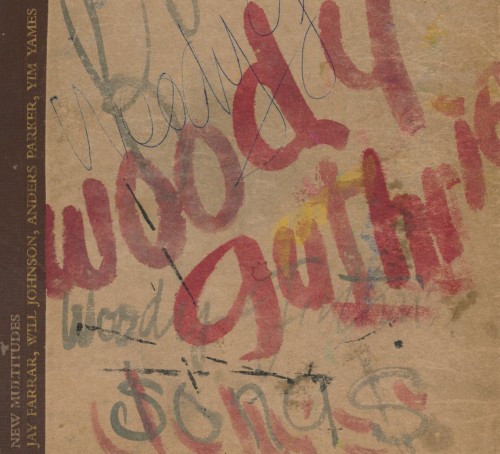
Jay Farrar, Will Johnson, Anders Parker & Yim Yames – New Multitudes


JAY FARRAR, WILL JOHNSON, ANDERS PARKER & YIM YAMES
New Multitudes
Rounder Records

Woody Guthrie’s astounding writing career – not just songs; also books, poems, letters, newspaper columns and more – was brief, less than 20 years. He began in the mid-1930s and it was over by about 1954 when he was hospitalized with Huntington’s disease, the hereditary neurological disease that eventually robbed him of his life in 1967 at just 55.

It wasn’t too much time after Woody’s death that I, as a teenager, discovered his songs, books and records. I’ve been listening and reading for about 45 years. More recently, I’ve been fascinated with the work that Nora Guthrie has been doing to bring the thousands of her father’s unheard songs back to life.

When I first began listening to Woody Guthrie records, and to others doing Woody Guthrie songs, back in the 1960s, it was commonly said that Woody was so driven to write that he must have written about a thousand songs. Through Nora’s work at the Woody Guthrie Archives, we now know there were many more songs, about 3,000, and most of them have never been heard. Whatever tunes or melodies Woody wrote or adapted for them are forgotten or were never known.

Over the past two decades, some of these songs have come to life in new musical settings by a wide variety of artists – some in album-length projects, some in one-off settings. Among my favourite album-length projects have been Wonder Wheel by the Klezmatics, Ticky Tock by the German artist Wenzel, and last fall’s Note of Hope by various artists in collaboration with Rob Wasserman. What never fails to astound me is how wide-ranging Woody’s writing was – all of these newly come-to-light songs revealing more clues into the Guthrie mystery – and how adaptable his writing was to so many different styles and musical genres and how it continues to speak to very varied artists.

The four artists featured on New Multitudes are alt-country and indie rock veterans Jay Farrar, Anders Parker, Will Johnson and Yim Yames (Jim James). Their settings range from folkish to full tilt rock ‘n’ roll and the album is available in two versions: a single CD with 12 songs and a 2-CD deluxe set with an additional 11.

The CD booklet – at least in the deluxe version – has reproductions of Woody’s original lyrics to the 23 songs. And while a few songs are not dated, they date from as early as 1938 to as late as December 1954 when Woody was already hospitalized. It’s fascinating to me, as someone who is familiar with the narrative of Woody’s life, to listen to the songs within the context of when they were written.

Several were written during World War II when Woody served in the merchant marine and army. “Hoping Machine,” written in June 1942, and set to music here by Farrar, are words of advice and inspiration that seem simultaneously universal to everyone and particular to Woody himself. “When I Get Home,” written in 1944 and set to music by Parker, is written from the perspective of a soldier who’s seen too much of war but who also knows there’s much to be done in the fight for social justice at home. And “Atomic Dance,” written about seven weeks after the atomic bombs were dropped on Hiroshima and Nagasaki, and set to music here by Farrar, would seem to be a metaphorical attempt to understand the dawning of the nuclear age.

Several others were written during Woody’s Coney Island period, in the years after the War, when he was married to Marjorie Mazia Guthrie and they were raising their young children (including Arlo and Nora).

Among them is “Fly High,” set to music by Parker, perhaps the sweetest sounding song on the two CDs. It seems to be sung by a man who has walked out on love but is returning again, like he has before, to the love he regrets having messed up. Another is “My Revolutionary Mind,” set to music by Yames, in which Woody iterates his need for a woman who shares his political views.

A bunch of the songs date from the early-1950s, when Woody, already showing signs of Huntington’s disease spent time in California. Earlier songs from this period, like “Old L.A.,” written by Woody in 1950 and set to music by Parker are more lucid than some of the later ones. “Old L.A.,” actually sounds like it could have been an Eagles song from the 1970s.

But, Woody’s own understanding that something is wrong shows through in later songs. In “Talking Empty Bed Blues,” written in 1952 and set to music by Yames, Woody writes, “My neighbors all see me stumblin’ home; They c’n see there’s something pretty bad wrong.”

Another from that period is “San Antone Meat House.” The ‘meat house’ in question here is a brothel and the song is sung from the perspective of a prostitute whose life has pretty much been destroyed by her years in the meat house. It’s a scarier, more graphic step inside the more familiar house of the Rising Sun.

Scarier still is “Dope Fiend Robber,” written by Woody in December 1953 and set to music by Parker. It’s sung from the perspective of a strung out junkie who will stop at literally nothing to feed his jones and is filled with the kind of language and characterizations they now warn us about on cable TV movie channels. I have, of course, heard Woody’s recordings of traditional outlaw ballads like “Bad Lee Brown (Little Sadie)” and his own outlaw ballads like “Pretty Boy Floyd,” but those criminals were almost choir boys in comparison to the dope fiend robber.

A couple of songs written after Woody was hospitalized are particularly fascinating.

In “No Fear,” written December 8, 1954 at Brooklyn State Hospital, and set to music by Johnson, Woody writes like a man at peace with the inevitable given his illness, that he’s ready for death – a death that would actually be 13 years in coming.

And, in “Old Kokaine,” written that same month and set to music by Farrar, he writes like a man close to death, but not at peace thanks to the substances that he thought might have numbed the pain over the years of his deterioration – but didn’t.

The effects of Huntington’s disease can even be seen in the reproductions of Woody’s handwritten lyrics in the CD booklet. Compare his handwriting on those two songs to his handwriting of even a year or two earlier and then to the much earlier work.


There is much more in other songs beyond those I’ve mentioned. The lyrics on most of the songs on the album date from a period in which the United States was in the grip of McCarthyism and striding almost blindly into the age of nuclear proliferation and there are references to such developments in several songs.

As these songs – and others that have surfaced from the Archives over the past 20 years – reveal, Woody Guthrie was a much more complex thinker and writer than we ever could have known. Each of these projects of songs from the Archives fills in just a little bit more of our understanding.

Note: This review is based on the 2-CD deluxe edition of New Multitudes. A single CD version (the first of the two CDs in the deluxe version) is also available. But some of the songs I’ve mentioned are only available in the deluxe version.

Pictured: Mike Regenstreif, Nora Guthrie, Kris Kristofferson and Jimmy LaFave talk about the enduring legacy of Woody Guthrie at the 2007 Ottawa Folk Festival.

I'm now on Twitter. twitter.com/@mikeregenstreif

I'm also on Facebook. www.facebook.com/mikeregenstreif

--Mike Regenstreif

Thursday, April 19, 2012

Kat Goldman – Gypsy Girl

KAT GOLDMAN
Gypsy Girl

(This review is from the April 23, 2012 issue of the Ottawa Jewish Bulletin.)

In 2004, Kat Goldman was a promising Toronto-based singer and songwriter preparing to move to New York where her music was causing a stir. Goldman’s first CD, The Great Disappearing Act, had been released in 2000 to critical acclaim and “Annabel,” a song from that album, found favour with a number of other artists, including the Winnipeg band, The Duhks, who recorded it on a Juno-nominated CD. The song also inspired the Giller Prize-nominated novel, Annabel by author Kathleen Winter.

But the move to New York never happened because Goldman was seriously injured when a car crashed into a bagel shop she was visiting, necessitating multiple surgeries and two years of rehabilitation. She came back with a second CD, Sing Your Song, in 2007, and has now released the lovely Gypsy Girl, her third.

Reflecting the transitory implications of her album’s title track, Goldman now divides her time between Toronto and Boston where she studies English literature at Harvard and Boston Universities. Some of the songs were recorded in Boston and some in Toronto; all of them written with poetic craftsmanship and compelling melodies enhanced by arrangements which blend both folk and pop influences.

Among the highlights are “World Away,” inspired by her intertwined lives as a Toronto singer and songwriter and Boston student; “Letter From Paris,” in which she seemingly escapes or hides from both identities; and, perhaps, best of all, “Gypsy Girl,” in which she sings about the compulsion to move and to travel and to explore new places which drives so many artistic souls.

I'm now on Twitter. twitter.com/@mikeregenstreif

I'm also on Facebook. facebook.com/mikeregenstreif


 --Mike Regenstreif