Thursday, May 17, 2012

John McCutcheon – This Land: Woody Guthrie’s America


JOHN McCUTCHEON
This Land: Woody Guthrie’s America
Appalseed Productions

This coming July 14 will be the 100th anniversary of the birth of Woody Guthrie, one of the most important and influential folksingers and songwriters of the 20th century. A number of CD projects celebrating Woody’s centennial have already been released and there are more to come – including Woody at 100: The Woody Guthrie Centennial Collection, a 3-CD box set from Smithsonian Folkways which will include 21 previously unreleased performances, among them six previously unheard songs.

While both of the Woody centennial CD projects I’ve already reviewed – Note of Hope and New Multitudes – have concentrated on settings of unknown or unheard songs from the Woody Guthrie Archives, most of John McCutcheon’s collection, This Land: Woody Guthrie’s America, is devoted to songs from the canon of classic Woody Guthrie songs. John also includes two songs from the Archives that he set to music; another that was set to music by Slaid Cleaves; and a recitation taken from Woody’s writing.

This Land: Woody Guthrie’s America is an apt title for this collection. Woody’s writing is deeply patriotic. But Woody’s is not a blind – ‘My country right or wrong’ or ‘America: Love it or leave it’ – kind of patriotism. No, his kind of patriotism, as seen in many of the songs in this collection including “Pastures of Plenty,” “I Ain’t Got No Home,” “Deportees,” “Pretty Boy Floyd,” “Ludlow Massacre,” “1913 Massacre,” and, perhaps most significantly, in “This Land is Your Land,” is a patriotism centered on compassion and justice, on righting the wrongs that make America less than it could be, as well as love of country.

While these songs date from 60 and more years ago, it’s amazing how relevant most of them still are to contemporary society. Woody was writing back then about how migrant workers are anonymously imported and deported; about the way the economic system creates an underclass; about how the rich exploit the poor for profit with no regard for human dignity – issues that are still with us today. While the event documented in “Deportees” took place in 1948, it could just as easily have been 2012.

But, as John notes in his liner essay, Woody Guthrie’s America was/is also a place with “children to put to sleep, lovers to serenade, outrageous boasts to shout, heroes to celebrate,” so the collection includes songs for those things too.

I’ll call special attention to the two songs from the Woody Guthrie Archives set to music by John. “Harness Up the Day” is a beautiful, poetic love song – a precursor by 20-something years to Bob Dylan’s “Tomorrow is a Long Time; and “Old Cap Moore,” a delightful tribute to a neighborhood hero.

John uses a wide range of musical settings on this album from his solo vocal and banjo version of “Pretty Boy Floyd,” to the rootsy band setting of “Biggest Thing That Man has Ever Done,” to the chamber-folk arrangement of “I Ain’t Got No Home.”

The most elaborate arrangement is certainly the stirring rendition of “This Land is Your Land,” in which John trades verses with Maria Muldaur, Tom Paxton and Willie Nelson. The spoken recitation with concertina accompaniment to “This is Our Country Here” is a perfect lead-in to “This Land.”

Among the other musicians featured on various tracks are Tim OBrienTommy Emmanuel, Bryn Davies and Stuart Duncan.

From beginning to end – the album ends with Goebel Reeves’ “Hobo’s Lullaby,” often cited as Woody’s favorite song – This Land: Woody Guthrie’s America is a terrific collection.

My only quibble is that there’s no acknowledgement that some of the songs have been taken from previously released albums. The all-star version of “This Land is Your Land” is from a various artists collection for children called This Land is Your Land (Songs of Unity). “Pastures of Plenty” is from a duo album John did with Tom Chapin, and the versions of “Mail Myself to You,” “Harness Up the Day,” “Howjadoo” and “Old Cap Moore” are from John McCutcheon albums dating as far back as 1988. I certainly don’t have a problem with the inclusion of the older recordings – I just think it should be made clear that the album includes both new recordings and previously released material.

Quibble aside, I have no hesitation in offering this album my highest recommendation.


I'm now on Twitter. twitter.com/@mikeregenstreif

I'm also on Facebook. www.facebook.com/mikeregenstreif

--Mike Regenstreif

Sunday, May 13, 2012

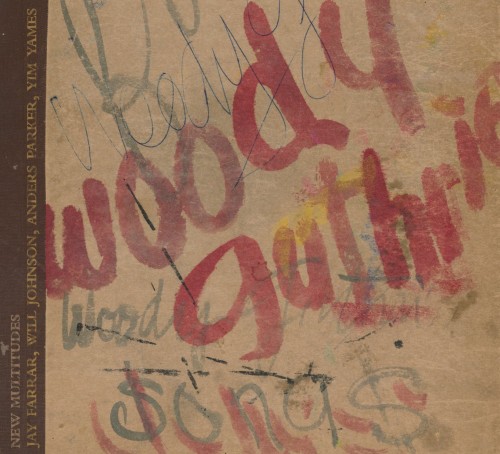
Jay Farrar, Will Johnson, Anders Parker & Yim Yames – New Multitudes


JAY FARRAR, WILL JOHNSON, ANDERS PARKER & YIM YAMES
New Multitudes
Rounder Records

Woody Guthrie’s astounding writing career – not just songs; also books, poems, letters, newspaper columns and more – was brief, less than 20 years. He began in the mid-1930s and it was over by about 1954 when he was hospitalized with Huntington’s disease, the hereditary neurological disease that eventually robbed him of his life in 1967 at just 55.

It wasn’t too much time after Woody’s death that I, as a teenager, discovered his songs, books and records. I’ve been listening and reading for about 45 years. More recently, I’ve been fascinated with the work that Nora Guthrie has been doing to bring the thousands of her father’s unheard songs back to life.

When I first began listening to Woody Guthrie records, and to others doing Woody Guthrie songs, back in the 1960s, it was commonly said that Woody was so driven to write that he must have written about a thousand songs. Through Nora’s work at the Woody Guthrie Archives, we now know there were many more songs, about 3,000, and most of them have never been heard. Whatever tunes or melodies Woody wrote or adapted for them are forgotten or were never known.

Over the past two decades, some of these songs have come to life in new musical settings by a wide variety of artists – some in album-length projects, some in one-off settings. Among my favourite album-length projects have been Wonder Wheel by the Klezmatics, Ticky Tock by the German artist Wenzel, and last fall’s Note of Hope by various artists in collaboration with Rob Wasserman. What never fails to astound me is how wide-ranging Woody’s writing was – all of these newly come-to-light songs revealing more clues into the Guthrie mystery – and how adaptable his writing was to so many different styles and musical genres and how it continues to speak to very varied artists.

The four artists featured on New Multitudes are alt-country and indie rock veterans Jay Farrar, Anders Parker, Will Johnson and Yim Yames (Jim James). Their settings range from folkish to full tilt rock ‘n’ roll and the album is available in two versions: a single CD with 12 songs and a 2-CD deluxe set with an additional 11.

The CD booklet – at least in the deluxe version – has reproductions of Woody’s original lyrics to the 23 songs. And while a few songs are not dated, they date from as early as 1938 to as late as December 1954 when Woody was already hospitalized. It’s fascinating to me, as someone who is familiar with the narrative of Woody’s life, to listen to the songs within the context of when they were written.

Several were written during World War II when Woody served in the merchant marine and army. “Hoping Machine,” written in June 1942, and set to music here by Farrar, are words of advice and inspiration that seem simultaneously universal to everyone and particular to Woody himself. “When I Get Home,” written in 1944 and set to music by Parker, is written from the perspective of a soldier who’s seen too much of war but who also knows there’s much to be done in the fight for social justice at home. And “Atomic Dance,” written about seven weeks after the atomic bombs were dropped on Hiroshima and Nagasaki, and set to music here by Farrar, would seem to be a metaphorical attempt to understand the dawning of the nuclear age.

Several others were written during Woody’s Coney Island period, in the years after the War, when he was married to Marjorie Mazia Guthrie and they were raising their young children (including Arlo and Nora).

Among them is “Fly High,” set to music by Parker, perhaps the sweetest sounding song on the two CDs. It seems to be sung by a man who has walked out on love but is returning again, like he has before, to the love he regrets having messed up. Another is “My Revolutionary Mind,” set to music by Yames, in which Woody iterates his need for a woman who shares his political views.

A bunch of the songs date from the early-1950s, when Woody, already showing signs of Huntington’s disease spent time in California. Earlier songs from this period, like “Old L.A.,” written by Woody in 1950 and set to music by Parker are more lucid than some of the later ones. “Old L.A.,” actually sounds like it could have been an Eagles song from the 1970s.

But, Woody’s own understanding that something is wrong shows through in later songs. In “Talking Empty Bed Blues,” written in 1952 and set to music by Yames, Woody writes, “My neighbors all see me stumblin’ home; They c’n see there’s something pretty bad wrong.”

Another from that period is “San Antone Meat House.” The ‘meat house’ in question here is a brothel and the song is sung from the perspective of a prostitute whose life has pretty much been destroyed by her years in the meat house. It’s a scarier, more graphic step inside the more familiar house of the Rising Sun.

Scarier still is “Dope Fiend Robber,” written by Woody in December 1953 and set to music by Parker. It’s sung from the perspective of a strung out junkie who will stop at literally nothing to feed his jones and is filled with the kind of language and characterizations they now warn us about on cable TV movie channels. I have, of course, heard Woody’s recordings of traditional outlaw ballads like “Bad Lee Brown (Little Sadie)” and his own outlaw ballads like “Pretty Boy Floyd,” but those criminals were almost choir boys in comparison to the dope fiend robber.

A couple of songs written after Woody was hospitalized are particularly fascinating.

In “No Fear,” written December 8, 1954 at Brooklyn State Hospital, and set to music by Johnson, Woody writes like a man at peace with the inevitable given his illness, that he’s ready for death – a death that would actually be 13 years in coming.

And, in “Old Kokaine,” written that same month and set to music by Farrar, he writes like a man close to death, but not at peace thanks to the substances that he thought might have numbed the pain over the years of his deterioration – but didn’t.

The effects of Huntington’s disease can even be seen in the reproductions of Woody’s handwritten lyrics in the CD booklet. Compare his handwriting on those two songs to his handwriting of even a year or two earlier and then to the much earlier work.


There is much more in other songs beyond those I’ve mentioned. The lyrics on most of the songs on the album date from a period in which the United States was in the grip of McCarthyism and striding almost blindly into the age of nuclear proliferation and there are references to such developments in several songs.

As these songs – and others that have surfaced from the Archives over the past 20 years – reveal, Woody Guthrie was a much more complex thinker and writer than we ever could have known. Each of these projects of songs from the Archives fills in just a little bit more of our understanding.

Note: This review is based on the 2-CD deluxe edition of New Multitudes. A single CD version (the first of the two CDs in the deluxe version) is also available. But some of the songs I’ve mentioned are only available in the deluxe version.

Pictured: Mike Regenstreif, Nora Guthrie, Kris Kristofferson and Jimmy LaFave talk about the enduring legacy of Woody Guthrie at the 2007 Ottawa Folk Festival.

I'm now on Twitter. twitter.com/@mikeregenstreif

I'm also on Facebook. www.facebook.com/mikeregenstreif

--Mike Regenstreif

Thursday, April 19, 2012

Kat Goldman – Gypsy Girl

KAT GOLDMAN
Gypsy Girl

(This review is from the April 23, 2012 issue of the Ottawa Jewish Bulletin.)

In 2004, Kat Goldman was a promising Toronto-based singer and songwriter preparing to move to New York where her music was causing a stir. Goldman’s first CD, The Great Disappearing Act, had been released in 2000 to critical acclaim and “Annabel,” a song from that album, found favour with a number of other artists, including the Winnipeg band, The Duhks, who recorded it on a Juno-nominated CD. The song also inspired the Giller Prize-nominated novel, Annabel by author Kathleen Winter.

But the move to New York never happened because Goldman was seriously injured when a car crashed into a bagel shop she was visiting, necessitating multiple surgeries and two years of rehabilitation. She came back with a second CD, Sing Your Song, in 2007, and has now released the lovely Gypsy Girl, her third.

Reflecting the transitory implications of her album’s title track, Goldman now divides her time between Toronto and Boston where she studies English literature at Harvard and Boston Universities. Some of the songs were recorded in Boston and some in Toronto; all of them written with poetic craftsmanship and compelling melodies enhanced by arrangements which blend both folk and pop influences.

Among the highlights are “World Away,” inspired by her intertwined lives as a Toronto singer and songwriter and Boston student; “Letter From Paris,” in which she seemingly escapes or hides from both identities; and, perhaps, best of all, “Gypsy Girl,” in which she sings about the compulsion to move and to travel and to explore new places which drives so many artistic souls.

I'm now on Twitter. twitter.com/@mikeregenstreif

I'm also on Facebook. facebook.com/mikeregenstreif


 --Mike Regenstreif
Wednesday, April 18, 2012

The Other Europeans - Splendor

THE OTHER EUROPEANS
Splendor
Kikiyon

(This review is from the April 23, 2012 issue of the Ottawa Jewish Bulletin.)

The Other Europeans are 14 musicians from eight different countries in Europe and North America – eight of whom form a klezmer ensemble and six of whom comprise a lautar ensemble. Lautar is the music of Eastern European Roma (Gypsies). Some of the selections on Splendor, a splendid two-CD set recorded live at the Yiddish Summer Weimar in Germany in 2009, feature one or the other of the two ensembles, or parts thereof, while much of the album has all 14 of the musicians playing together.

The Other Europeans project has been spearheaded by pianist and accordionist Alan Bern, perhaps best known for his work as a member of Brave Old World, a band at the forefront of the creation of new Jewish music over the past couple of decades. Other members of the Klezmer Ensemble include clarinet and saxophone player Christian Dawid; Matt Darriau of the Klezmatics on kaval, piccolo, clarinet and saxophone; and Mark Rubin, who started his career as a member of the alt-country duo Bad Livers, on tuba and bass.

Among the members of the Lautar Ensemble are cimbalom player Kalman Balogh; accordionist Petar Ralchev; and trumpeter Adam Stinga.

Historically, as Walter Zev Feldman, mentions in his liner notes, Jewish and Roma musicians had little, if any, interaction in most areas of Eastern Europe except in Greater Hungary, primarily in the 18th century, and in Moldova, particularly in the province of Bessarabia, from the 18th century until the Holocaust. The music also crossed over to North America with Jewish immigrants in the late-19th and early-20th centuries but declined in both America and Moldova by the 1950s – in America due to assimilationist tendencies, and in Moldova due to the Soviet policy of creating a Moldovan ethnic music that was, as Feldman notes, “free from Jewish influence.”

The repertoire which the Other Europeans explore on Splendor – and which they perform brilliantly – is the klezmer and lautar music played in Bessarabia before the Second World War. Whether in the smaller klezmer and lautar groupings, or in the combined forces of the full ensemble, the music is compelling, exciting and beautiful.

Among my favourite selections from the klezmer repertoire are “Khaiterma,” a delightful classic which features Darriau on clarinet bouncing his notes off Rubin’s slap-bass playing; and the two-part “Klezmer Suite #1,” particularly the wild second part.

My favourite lautar selection is the two-part “Lautar Clarinet Suite #1,” which begins with a in a slow, contemplative mode before picking up steam. The piece almost seems classical.

And, of course, the tracks featuring all of the Other Europeans are a constant delight. Among the most beautiful and exciting pieces is the album-ending concert encore of Sârba de la nord.”

The similarities and contrasts of the Jewish and Roma influences in this music are fascinating. Alan Bern has done a sensational job of tying it all together in the Other Europeans.


--Mike Regenstreif

Sunday, April 15, 2012

Dave Carter & Tracy Grammer – Little Blue Egg


DAVE CARTER & TRACY GRAMMER
Little Blue Egg
Red House Records

Dave Carter was already into his mid-40s when he – and partner Tracy Grammer, who played violin and sang harmony – suddenly emerged in 1998 with an album called When I Go, an album which served notice that Dave was one of the most compelling and enigmatic singer-songwriters of our time. Then, after two more superb albums and concert and festival tours that established Dave and Tracy at the front ranks of the contemporary folk scene, Dave died suddenly in 2002 of a massive coronary, just weeks before his 50th birthday.

Those three albums by Dave Carter and Tracy Grammer, and a fourth, Seven is the Number, his final recordings, released posthumously, are among the most essential folk-rooted recordings of recent years.

Recently, Tracy discovered some demos recorded in their home studio between 1997 and 2002 and chose 11 of the songs – 10 of Dave’s and a superb version of “Way Over Yonder in the Minor Key,” lyrics by Woody Guthrie set to music by Billy Bragg for the Mermaid Avenue project – for Little Blue Egg, another most essential addition to Dave and Tracy’s discography.

Of the 10 songs written by Dave, I first heard three – “Hard to Make It,” “Any Way I Do” and “Gypsy Rose” – on Tracy’s excellent 2005 solo album, Flower of Avalon. The rest are new to me.

Among this album’s highlights are “Gypsy Rose,” a beautiful, poetic love song; “Cross of Jesus,” which describes three very different people – two in the third-person, one in the first-person – united by the crosses they wear and the sincerity with which they live their lives; and “September Sea,” in which Dave seems to have a prescient understanding that his life would be short and that Tracy would keep his flame alive.

Dave Carter is one of those rare songwriters whose work continues to reveal more with repeated listening over many years. The songs on Little Blue Egg are a welcome addition to his canon.


--Mike Regenstreif

Saturday, April 14, 2012

Guy Davis – The Adventures of Fishy Waters: In Bed with the Blues

GUY DAVIS
The Adventures of Fishy Waters: In Bed with the Blues
Smokeydoke Records

Fishy Waters is a fictional character, an old time blues musician, created by Guy Davis for The Adventures of Fishy Waters: In Bed with the Blues, a one-man theatrical play in which Fishy Waters reminisces about his life, telling stories and singing songs, in a way that provides audiences with insight and context into the lives of early blues musicians and more particularly, into the times and societal situations that shaped their lives and music.

Guy has performed in productions of The Adventures of Fishy Waters a number of times since its debut in 1994 and has now released this 2-CD set as an audio play version. Although I’ve never seen the full production on stage, I have seen Guy do several excerpts over the years during club and festival concerts, so I eagerly looked forward to at least hearing the complete version. As I expected, listening to it was a rich and rewarding experience. If I was still doing my radio program, I would have played each of the two CDs from start to finish with hardly an interruption.

The stories Fishy Waters tells range from a humorous description of a one-legged grave robber to a devastating description of encountering a KKK lynching of a young African American boy.

While most of the production is devoted to stories, the play integrates a bunch of superbly performed songs – some of Guy’s own written in traditional styles as well as classics drawn from Reverend Gary Davis, Blind Willie McTell, Robert Johnson (who Guy has also played on stage) and Big Bill Broonzy.

Although, by now, Guy is probably best known as a blues musician, he is also an actor of substantial talent – something he probably comes by naturally as the son of acclaimed theatre and film actors Ossie Davis and Ruby Dee. In The Adventures of Fishy Waters: In Bed with the Blues, he blends his acting and musical talents to superb effect.

Listening to Guy as Fishy Waters tell these stories reminds me of listening to the likes of Sonny Terry & Brownie McGhee, Jay McShann, Howard "Louie Bluie" Armstrong, and other blues legends I've had the opportunity to know tell their first-hand accounts.

Pictured: Guy Davis and Mike Regenstreif at the 2006 Champlain Valley Folk Festival.

I'm now on Twitter. twitter.com/@mikeregenstreif

--Mike Regenstreif

Sunday, April 1, 2012

Caroline Doctorow – I Carry All I Own: The Songs of Mary McCaslin

CAROLINE DOCTOROW
I Carry All I Own: The Songs of Mary McCaslin
Narrow Lane Records

Back in the 1970s, I was part of an extended circle of friends that spent a lot of time hanging around a barn in North Ferrisburg, Vermont – about a two-hour drive from Montreal – that had been converted into a recording studio and was home to Philo Records, one of the most interesting, and, for about 10 years, one of the most vital, of the folk-rooted record labels of the time.

Among the artists I became friends with was Mary McCaslin, an influential singer and songwriter and a guitarist known for her innovative use of open tunings. Several of Mary’s Philo recordings, in particular Way Out West and Prairie in the Sky, remain contemporary folk classics whose songs have turned up on recordings by such artists as Tom Russell, Gretchen Peters, Stan Rogers, Sneezy Waters, David Bromberg, Kate Wolf, and Bill Staines. Many of Mary’s songs featured imagery from the old and new west and her Prairie in the Sky LP inspired Ian Tyson to return to songwriting, thus precipitating the renaissance of cowboy culture.

Three years ago, contemporary singer-songwriter Caroline Doctorow released Another Country, an album of Richard and Mimi Fariña songs, the first in a series of planned tributes to artists who influenced her. I Carry All I Own: The Songs of Mary McCaslin is the second in the series and, like the Fariña tribute, it was produced by multi-instrumentalist Pete Kennedy. All of the back-up complementing Caroline’s voice and guitar on this CD is by Pete.

It’s a lovely tribute encompassing 10 songs drawn from three of Mary’s Philo albums from the ‘70s (one of which, Sunny California, was initially licensed to Mercury Records) and one from A Life and Time, a 1981 recording on Flying Fish (interestingly, both the Philo and Flying Fish catalogs were eventually absorbed by Rounder Records). Caroline’s singing and the arrangements remain faithful enough to Mary’s originals that they are instantly recognizable to those of us who knew this music back in the day and yet are just different enough that they have a contemporary freshness all their own.

While I really enjoyed the whole album, among my favourite tracks are “Circle of Friends,” which always reminds me of sitting up late at night with Mary and other friends from the era; “Young Westley,” a fictionalized outlaw-ballad-cum-love-song at least partially inspired by Mary’s early relationship with singer-songwriter Jim Ringer, to whom she was later married; and a beautifully dreamy, atmospheric rendition of “Prairie in the Sky.”

I’ve no doubt Mary will feel justifiably honoured by Caroline’s fine tribute.

Pictured: Mike Regenstreif and Mary McCaslin at the 1999 Champlain Valley Folk Festival.

I'm now on Twitter. twitter.com/@mikeregenstreif

--Mike Regenstreif

Saturday, March 31, 2012

Bruce Cockburn, Wailin’ Jennys win Junos


As usual, all the Juno Award categories that I actually have any interest in (Roots/Traditional, blues, world, etc.) were awarded the night before the televised award show, thus relieving me of any reason to pay attention, let alone tune in tomorrow.

Congratulations to Bruce Cockburn who won the Roots/Traditional (solo) award for Small Source of Comfort (click here for my review) and to the Wailin’ Jennys who won the Roots/Traditional (group) award for Bright Morning Stars (click here for my review).

Congratulations also to True North Records which released both albums.

--Mike Regenstreif

Eric Bibb – Deeper in the Well

ERIC BIBB
Deeper in the Well
Stony Plain

Although he’s been an accomplished musician since he was a teenager in the 1960s, Eric Bibb really only landed on my radar in 1998 with the release of an inspired and inspiring album called Good Stuff.

I soon discovered Eric was the son of actor and folksinger Leon Bibb (who was a prominent participant in the post-War folk revival) – and the godson of Paul Robeson and the nephew of pianist John Lewis of the Modern Jazz Quartet, talk about a musical pedigree – and that I was previously unfamiliar with Eric because he’d spent most of his career living and performing in Europe.

Good Stuff launched Eric’s career in North America and he was soon a significant presence on the folk, blues and jazz festival circuit. He was my guest several times on the Folk Roots/Folk Branches radio program when he’d come to play at the Montreal International Jazz Festival.

Since Good Stuff, Eric has recorded prolifically, both solo albums and collaborations with other artists, and I’ve written about many of them here and in various publications. These albums have almost always been among my favourites for any year they’ve been released and are all albums I’ve returned to often over the years. His new album, Deeper in the Well, will be no exception.

To keep all of his recordings sounding fresh, Eric has done things a little differently from album to album. This time around, he travelled to Louisiana to record at Dirk Powell’s studio in Pont Breaux with Dirk, who plays just about anything with strings, plus accordion; fiddler Cedric Watson; drummer Danny DeVillier; harmonica player Grant Dermody, who contributed so much to Eric’s Booker’s Guitar album in 2010; and Christine Balfa on Cajun triangle.

A little over half the album’s songs are Eric’s originals, including “Bayou Belle,” the appropriately swampy opening track that blends the acoustic blues Eric is so expert at with the Cajun and Creole influences of Louisiana.

As with all of Eric’s albums, it’s hard to pick favourites. But a few of mine from initial listening would include “Money in Your Pocket,” a count-your-blessings kind of song co-written with Michael Jerome Browne; “Music,” an infectious celebration of music-making; a happy sounding version of “Dig a Little Deeper in the Well,” learned ago from Doc Watson; and a thoughtful version of Bob Dylan’s “The Times There are A-Changin’” which Eric makes sound as vital in 2012 as it was almost half a century ago.

While it doesn’t say so in the credits, there are a couple of equally excellent tracks that I suspect were recorded, at least partially, elsewhere. Eric’s “In My Time,” which contrasts good times and hard times, brings together Eric’s soulful singing, and fluid, finger-picked guitar, with the sublime playing of dobro-master Jerry Douglas; and an almost West African-sounding version of Taj Mahal’s “Every Wind in the River” features back-up by master-of-all-roots music Michael Jerome Browne and studio wiz Michel Pepin, both of Montreal.

As mentioned, Deeper in the Well is yet another Eric Bibb album I’ll be listening to years from now.

Pictured: Michael Jerome Browne, Mike Regenstreif and Eric Bibb during Folk Roots/Folk Branches at CKUT, June 30, 2005, (Photo: Sari Matinlassi) 

I'm now on Twitter. twitter.com/@mikeregenstreif

I'm also on Facebook at https://www.facebook.com/mikeregenstreif

--Mike Regenstreif

Sunday, March 25, 2012

Dan Livingstone and the Griffintown Jug Addicts

DAN LIVINGSTONE AND THE GRIFFINTOWN JUG ADDICTS
Dan Livingstone and the Griffintown Jug Addicts

Dan Livingstone and the Griffintown Jug Addicts take their inspiration from the original jug bands that played and recorded around Memphis in the 1920s and ‘30s, and 1960s revival groups Jim Kweskin & the Jug Band.

The Montreal-based group which gelled playing weekly gigs at the Griffintown Café are a lot fun to listen to with their juggy interpretations of classics drawn (mostly) from the delta and Piedmont blues traditions.

Dan Livingstone sings with appropriate bluster and he’s an accomplished guitar player – whether running a slide up and down the neck on Mississippi Fred McDowell tunes or picking out the intricate finger-style patterns on tunes by Blind Blake, Blind Boy Fuller, Reverend Gary Davis, Merle Travis and John Fahey (who I used to bring to Montreal to play at the Golem in the 1970s and ‘80s).

Livingstone gets solid support from Jug Addicts Julia Narveson on washtub bass and Brad Levia on washboard – both of whom also played with the sadly disbanded Lake of Stew – and Colin Perry, known for his work leading the blues band Blind, on lead guitar and tenor banjo.

Among the highlights are bouncy versions of Blake’s “Chump Man Blues,” Fuller’s “Rag, Mama, Rag” (which should not be confused with The Band’s similarly-named song) and Fahey’s “Last Steam Engine Train,” the only instrumental.

Another is a perfectly campy version of Travis’ “I Like My Chicken Frying Size,” featuring Dom Desjardins on tenor banjo and Jérome Dupuis-Cloutier on trumpet added to the band.

At just nine songs and 35 minutes, the CD is over much too fast. I hope to hear more from them sooner than later.

--Mike Regenstreif

Saturday, March 17, 2012

Eric Taylor – Live at the Red Shack

ERIC TAYLOR
Live at the Red Shack
Blue Ruby Music & Records

Back in the 1980s, Nanci Griffith was a regular performer at the Golem, the Montreal folk club I was running in those days. Like many of the artists who played the Golem, Nanci stayed with me and we’d often sit up, late at night, talking about music, musicians, singers, songs and songwriters. One of the people she told me about was her ex-husband, a great songwriter, troubled in those days, named Eric Taylor. I’d had a bit of an introduction to Eric via his song, “Dollar Matinee,” which he performed with Nanci on her first LP, There’s a Light Beyond These Woods.

Eric grew up in Georgia and arrived on the Texas folk scene in the early-1970s. Following in the footsteps of songwriters like Townes Van Zandt and Guy Clark, he was one of the best of the next wave of singer-songwriters in a scene known for its great writers. Eric released his first LP, Shameless Love, in 1981, and then pretty much disappeared for more than a decade.

I was doing the Folk Roots/Folk Branches radio show when Eric re-emerged in the mid-1990s with the eponymously named Eric Taylor, a CD which re-established Eric’s place in the front ranks of contemporary folk-based singer-songwriters. That album, and a series of excellent releases that followed, were staples on the radio show for its entire run.

For Live at the Red Shack, Eric took some songs from his extensive back catalogue – including a couple that have only been available on Nanci Griffith or Lyle Lovett albums and another that was (so far as I know) previously unrecorded – into the Red Shack, a Houston recording studio, and performed them live to a small audience of invited guests. Backing Eric throughout the album are Marco Python Fecchio, an excellent, atmospheric electric guitarist and James Gilmer, a very tasteful percussionist. Nanci, Lyle, Denice Franke and Susan Lindfors Taylor provide duet and/or harmony vocals to some of the songs.

Something I’ve always loved about Eric’s work is that he’s not a navel-obsessed songwriter. Many of his songs are from the perspective of a character completely, or at least seemingly, outside of himself. In one song, he’s a guy from Indiana who just happened to be a tourist in the crowd when John F. Kennedy was assassinated in Dallas. In another, he’s a guy in a saloon in Deadwood, South Dakota when news about the death of Crazy Horse comes through in 1877. And, in yet another, he’s a character in Jack Kerouac’s On the Road talking about Dean Moriarty. And in all of these settings, and others, he seems to be singing with complete honesty and authenticity.

Without question, these are all great versions of great songs, but I’ll call attention to a few of my favorite tracks.

One is certainly the afore mentioned “Dean Moriarty,” doubled in length by a spoken word into that sounds like it could have been written by Kerouac back in the day. Another is “Mission Door,” with chorus harmony from Nanci, a beautifully constructed portrait of skid row life. And yet another is a gorgeous duet with Denice Franke on “Blue Piano,” which captures a scene from many years ago of Bonnie Brown playing the painted-blue piano at Anderson Fair, a legendary Houston music club.

It was also great to hear Eric and Nanci reprising their version of “Dollar Matinee,” first recorded on Nanci’s debut album in 1978, and to hear Eric and Lyle team up on “Memphis Midnight, Memphis Morning,” an Eric Taylor song Lyle recorded on Step Inside This House, an album he made in tribute to influential Texas songwriters.

If you appreciate great singer-songwriters, you should be listening to Eric Taylor.

--Mike Regenstreif

Saturday, March 10, 2012

Montreal concerts: Tom Paxton, Jesse Winchester

Jesse Winchester
Matt Large and Rebecca Anderson of Hello Darlin’ Productions in Montreal have lined up a superb set of concerts this spring. Among the artists are some of the brightest young performers on the contemporary folk scene and several bona fide legends.

I want to pay particular attention to back-to-back concerts on Saturday and Sunday, April 21 and 22, featuring two legendary and great singer-songwriters, two artists I’ve had the privilege of working with many times over the years, and two men I’ve been honoured to share friendship with over many decades.

Tom Paxton performs Saturday, April 21 and Jesse Winchester performs Sunday April 22. Both concerts are at 8:00 pm at Petit Campus (57 Prince Arthur East). Visit the Hello Darlin’ website or call 514-524-9225 for tickets or more information; call for a special deal being offered if you buy tickets for both concerts.

Tom Paxton
A story I’ve told before dates back to 1968 or ’69, when I was 14, or maybe just turned 15. I heard there was going to be a big folk concert at McGill University and decided to go. It was a bunch of local acts doing short sets in the first half and a headliner from New York in the second. When I got there, I discovered it was a “blanket concert”: thousands of McGill students – four, five, six and more years older than me – sitting on blankets on the floor of a huge gym. It was pretty full and I had no blanket so I sat on a long bench that lined the back of the gym wall back. Between acts, I had an interesting conversation with the man sitting next to me. He obviously knew a lot about folk music and gave me some suggestions on records to look for. When the intermission was announced, he said he enjoyed talking with me and left.

After the break, the MC, Tex König, introduced “one of the greatest of the Greenwich Village folksingers:  Tom Paxton!” That man I’d been talking to all night walked on stage and did an amazing hour-long set that I still vividly remember 40-odd years later.

That was the “it moment” for me. I started to listen to every record and read every folk music book I could find. I subscribed to Sing Out!, went to coffeehouses and concerts, and was soon a part of the action – hanging out, learning some guitar, producing concerts, running folk clubs, volunteering at folk festivals and writing articles and reviews. It became a way of life – and still is.

Mike Regenstreif & Tom Paxton
So, Tom Paxton, who, some years later, became a good friend, and who I’ve had the pleasure of working with a bunch of times in different contexts over the years, had a lot to do with drawing me into the folk music life.

Tom was one of the greatest singer-songwriters of the 1960s. Dave Van Ronk told me that Tom was the first Greenwich Village folksinger, even before Bob Dylan, who worked hard and consistently at songwriting. He’s never stopped and remains one of our greatest singer-songwriters today.

I’ve had the great pleasure of working with Tom in several different contexts. He played regularly at the Golem, the Montreal folk club I ran in the 1970s and ‘80s, always filling it to capacity, always doing great shows filled with a combination of great new songs and Paxton classics. When Robert Resnik and I booked and programmed the Champlain Valley Folk Festival in Burlington, Vermont in 2000 and 2001, Tom was the 2001 headliner and was part of the annual songwriters’ workshop I hosted there for seven years. And, of course, he was my guest on the Folk Roots/Folk Branches radio show,

Tom, for me, is one of the most special of artists.

So, too, is Jesse Winchester. In fact, I first encountered Jesse at that same McGill concert in 1968 or ’69. He, Penny Lang and Bruce Murdoch, were among the Montreal artists who played in the first half of that concert. It was before Jesse’s classic self-titled first album was released.

Again, as I’ve written before, Jesse is one of the great singer-songwriters of our time and there was a significant period of time when the Montreal folk scene had him almost to ourselves. A few quick anecdotes:

Jesse played often at the Golem, the Montreal folk club I ran in the 1970s and ‘80s. I took over the club at the end of May 1974 and Jesse’s first gig there was at the beginning of August. This was right about the time that his third LP, Learn to Love It, came out and all three nights were sold-out. Jesse, in those days, was not able to perform in the U.S. but was already attracting a lot of attention for his songwriting. A reporter from Rolling Stone magazine showed up and covered the gig as part of a story about Jesse. I believe it was the first time that Rolling Stone had ever covered a Montreal story.

Mike Regenstreif & Jesse Winchester
In November 1975, I was a backstage guest of Ramblin’ Jack Elliott (another Golem performer) at the Rolling Thunder Revues first Toronto concert. During the concert, Joan Baez dedicated a song to Jesse (Dave Loggins’ “Please Come to Boston” which has a line, “I’m the number one fan of the man from Tennessee”). I met Joan for the first time at the Rolling Thunder party after the show. When I mentioned that Jesse was a friend, Joan spent about half an hour grilling me about him.

In 1999, when Jesse released his first new album in 10 years, I was honoured that he chose to debut the album as a guest on the Folk Roots/Folk Branches radio show.

Jesse was a headliner in 2000, the first of two years that Robert Resnik and I programmed the Champlain Valley Folk Festival in Vermont. And, like Tom the following year, he was part of the annual songwriters’ workshop I hosted there.

After many years in Montreal and the Eastern Townships, Jesse remarried and now lives in Virginia with his wife, Cindy, so his return trips “home” to Montreal are special occasions to see and play for old friends. And this trip is doubly special because it will be his first visit since a serious health issue last year.

I’m looking forward to being in Montreal and seeing these two old friends next month.

And for folks in Toronto, Jesse will be at Hugh’s Room on April 13-14-15, and Tom will be there on April 20.

--Mike Regenstreif

Saturday, March 3, 2012

Jon Brooks – Delicate Cages

JON BROOKS
Delicate Cages

Delicate Cages, the fourth album in six years by Toronto-based singer-songwriter Jon Brooks, is an ambitious examination of some of the various “cages” of the human condition – some of them literal, some metaphorical, some of them based on real people, others drawn from the artists’ imagination, all of them, in one way or another, insisting that we look at the world, or, at least a small slice of it, through someone else’s eyes.

The ethos of the album is established in “Because We’re Free,” the opening song in which the narrator reflects on a series of natural disasters and human-caused catastrophes and questions why God didn’t prevent or alleviate such occurrences. The answer comes in the songs title which is repeated at the end of each chorus.

Among the most powerful songs are two that are based on real people.

“Son of Hamas,” was inspired by the book, Son of Hamas: A Gripping Account of Terror, Betrayal, Political Intrigue, and Unthinkable Choices, the autobiography of Mosab Hassan Yousef, the eldest son of a founder of the Islamic terrorist organization who worked clandestinely over a period of years to prevent terrorism. The song is a glimpse into the life of a heroic young man viewed as a traitor by his own family.

“The Lonesome Death of Aqsa Parvez,” is the story of a teenaged victim of a so-called honour killing, at the hands of her father and brother, which took place in a Toronto suburb in 2007.

The most infectious song is “Hudson Girl,” essentially a love song for Jon’s wife. But, it’s a love song with political overtones when the second verse explains that Jon’s Hudson girl, as a child moving with her family, was among those driven out of Quebec by Bill 101, the repressive language law – Jon gives thanks to Bill 101 in the song for delivering his wife to him.

Although many of these songs deal with difficult subject matter – and kudos to Jon’s fearlessness in tackling such material with the right mix of honesty and sensitivity – the album’s ultimate message is one of hope when Jon explains in “There Are Only Cages,” the penultimate track, that there is a good cage, “the cage of freedom” and “this cage of freedom is love.”

The album ends, with Jon by himself at the piano, playing a contemplative instrumental reprise of “Because We’re Free.”

Pictured: Jon Brooks and Mike Regenstreif at the 2010 Ottawa Folk Festival.

--Mike Regenstreif